SC Housing is offering $12,000 in down payment assistance along with competitive interest rate loans for Palmetto Heroes! The program is offered to eligible service personnel who provide vital support to South Carolina communities, these include teachers, nurses, law enforcement officers, correctional officers, fire fighters, emergency medical technicians, paramedics, veterans, active-duty military, and National Guard members.
The initiative is available on a first-come, first-served basis starting April 15th and requires an executed sales contract on a home. Funds get exhausted quickly and could be gone in a few months. Get pre-approved now so you can start looking for a home and secure your funds!
Rates for the program will be quoted on Monday, April 15th.
Eligibility is determined by South Carolina State Housing Finance and Development Authority.
If you’re planning to move soon, you might be wondering if there’ll be more homes to choose from, where prices and mortgage rates are headed, and how to navigate today’s market. If so, here’s what the professionals are saying about what’s in store for this season.
Odeta Kushi, Deputy Chief Economist, First American:
“. . . it seems our general expectation for the spring is that we will see a pickup in inventory. In fact, that already seems to be happening. But it won’t necessarily be enough to satiate demand.”
“Where we are right now is the best of both worlds. Price increases are slowing, which is good for buyers, and prices are still relatively high, which is good for sellers.”
“There are slightly more homes for sale than this time last year, and there is still plenty of competition for well-priced houses. Buyers should prep their credit scores and sellers should prep their properties now, attractive listings are going pending in less than a month, and time on market will shrink in the weeks ahead.”
“While mortgage rates remain elevated, home shoppers who are looking to buy this spring could find more affordable homes on the market than they saw at the same time last year. Specifically, there were 20.6% more homes available for sale ranging between $200,000 and $350,000 in February 2024 than a year ago, surpassing growth in other price ranges.”
If you’re looking to sell, this spring might be your sweet spot because there just aren’t many homes on the market. Sure, inventory is rising, but it’s nowhere near enough to meet today’s buyer demand. That’s why they’re still selling so quickly.
If you’re looking to buy, the growing number of homes for sale this spring means you’ll have more choices than this time last year. But be prepared to move quickly since there’ll be plenty of competition with other buyers.
If you need assistance buying or selling a home in the Charleston Area, feel free to contact me! I would be glad to help!
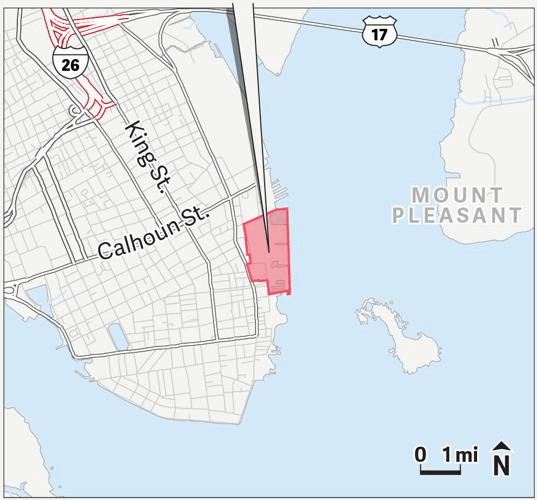
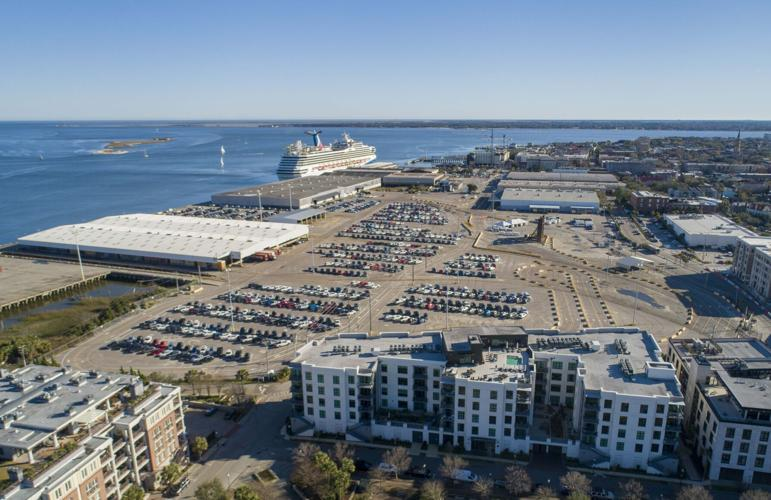
On March 19 2024, the State Ports Authority board approved the sale of Union Pier to a local billionaire businessman, Ben Navarro, The site is roughly 65-acres of waterfront property and is one of the most sought-after redevelopment properties on the East Coast.
The Union Pier site is located between Concord and Laurens streets, near the Historic District, and is on one of the peninsula’s most valuable pieces of property. The development of the parcel could be transformative for one of America’s oldest cities.
Financial terms of the Union Pier Sale won’t be released until the deal closes. But Bill Stern, chairman of the SPA;s board, said the deal is the best possible outcome for what he calls “probably the most valuable piece of oceanfront property on the East Coast” and something that will be “the center piece of downtown Charleston.” – reports the Post and Courier
Bill Stern also stated, about Ben Navarro, that “He has the ability to pull this off” and that “He wants to work with the city of Charleston. He wants to work with the Mayor. He wants to do what’s right for the people of Charleston. He’s going to put the resources into doing this right. That’s why we made this deal.”
Ben Navarro is the founder of Charleston-based Sherman Financial Group — which owns Credit One Bank — and Beemok Hospitality Collection — a family-owned operation with a portfolio that includes downtown Charleston properties such as The Charleston Place, the Riviera Theater, the Italian bistro Sorelle and The Cooper, a riverfront hotel under construction between Union Pier and the Joe Riley Waterfront Park.
Once the sale is completed, proposed plans could include high-density mix of condominiums, office space and retail, along with some parks, green space and waterfront access, but any redevelopment plans will require significant city input regarding zoning and code changes, environmental cleanup and more. The site will continue to serve as the port of embarkation for Carnival Cruise Line until the end of the year.
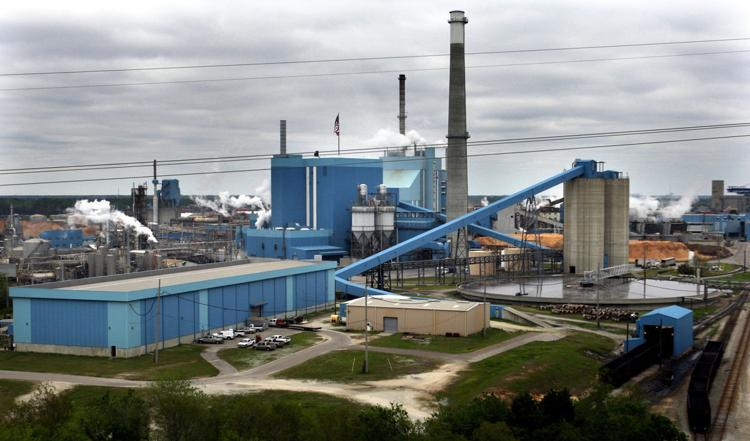
Additionally, The State Ports Authority will more than double the size of its North Charleston Terminal by purchasing the neighboring former WestRock paper mill property, giving the Port of Charleston enough room to grow through at least the middle of this century, the maritime agency said March 19.
The 280-acre WestRock property will give the terminal a 481-acre footprint and the capacity to handle 5 million shipping containers per year. That’s more than twice the capacity of the Wando Welch Terminal in Mount Pleasant, currently the SPA’s largest
The purchase price is $105 million, which also includes additional acreage WestRock owns in Berkeley County that is not waterfront.
Recognized as the No.1 master-planned community in the U.S. by the National Association of Home Builders (NAHB), Nexton is currently one of the Top 30 best-selling communities in the nation and has surpassed its 3,000th home sale in February 2024.
Nexton’s four unique neighborhoods feature local and national builders and include a diverse array of homes including villas, townhomes, cottages and single-family homes, with home prices ranging from $300,000 to over $1 million with an average home price of approximately $500,000.
Nexton has established itself as a live-work-play destination that features dining, shopping, services and hospitality. Nexton has delivered over 500,000 square feet of office space, attracting thousands of jobs, all in a walkable and bikeable environment adjacent to I-26.
Nexton also offers conveniences such as sought-after schools, grocery stores, modern infrastructure, 20 miles of trails and 2,000 acres of green space and high-quality apartment communities.
SC Housing Palmetto Heroes Program honors educators, first responders and community service personnel in the fields of law enforcement, corrections, firefighting, emergency medical services and health care, as well as active-duty military, members of the SC Army National Guard, SC Air National Guard and Veterans of the U.S. Armed Forces. The program typically offers a variety financing options with a reduced fixed interest rate AND Down Payment Assistance.
The program is first come first serve and lasts until funds are depleted. Last year (2023) the program featured $10,000 down payment assistance for qualified applicants. 2024 details have not been released yet, but should be announced very soon, within the coming weeks.
I am watching for the details of the new issue. If you are interested in this program, please contact me and I would be glad to help!
Title insurance is a form of indemnity insurance that protects lenders and homebuyers from financial loss that could be sustained from defects in a title to a property. The two basic types are The lender’s title insurance, which the borrower purchases to protect the lender and the other type is the owner’s title insurance.
A title search is completed before title insurance is issued. This is an examination of public records to determine and confirm a property’s legal ownership and determine whether there are any claims to the property. The goal is to pass “clear title”, free of any encumbrances or claims, to the new purchaser.
Title insurance protects against loss or damage occurring from liens, encumbrances, or defects in a property’s title that were unable to be detected during the title search. Some common claims that could subsequently be filed against a title are back taxes, liens, conflicting wills, forgeries and / or survey disputes. Unlike traditional insurance, which protects against future events, title insurance protects against claims for past occurrences.
Almost all lenders require the borrower to purchase a lender’s title insurance policy (usually detailed in the lender’s closing costs). A lender’s policy only protects the lender against loss. Buyers, at closing, typically have the option of purchasing an owner’s title policy that helps protects them from financial loss.
Since title searches are not infallible and an owner of real estate remains at risk of financial loss, it is wise to purchase protection in the form of an owner’s title insurance policy.
A basic owner’s title insurance policy typically covers the following hazards:
Encumbrances or judgments against property
Flawed records
Property border disputes
Encroachments
Easement disputes
Forged documents
Third-party claims
Errors in recorded documents
Incorrect property deed
Title insurance costs in South Carolina range from 0.5% to 1% of your home sale price. It’s a one-time fee, and the coverage lasts as long as you or your heirs own the property.
The legal costs to defend your title from any one of the title defects mentioned would far outweigh the cost of title insurance, thus making it a sensible purchase.
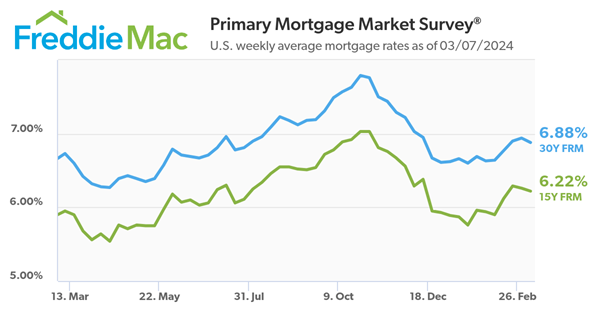
Freddie Mac reports the 30-year FRM averaged 6.88 percent as of March 7, 2024, down from last week when it averaged 6.94 percent. A year ago, at this time, the 30-year FRM averaged 6.73 percent.
As the rates took a small dip, mortgage applications rose, evidence that purchase demand remains sensitive to interest rate changes. Mortgage rates continue to be one of the biggest hurdles for potential homebuyers looking to enter the market.
Where are Rates Headed? No one has a crystal ball but here is what some experts are predicting:
Freddie Mac. With the current stance of monetary policy holding steady, we expect mortgage rates to move sideways, remaining above 6.5% through this quarter and drifting down to about 6% by year’s end. Fannie Mae Housing Forecast. The 30-year fixed rate mortgage will average 6.3% in Q2 2024 and slowly decline over the year, landing at a Q4 average of 5.9%.
National Association of Realtors chief economist Lawrence Yun. “The budget deficit remains high, and the various inflation metrics remain above the comfort level. That means the mortgage rates will likely be in the 6% to 7% range for most of the year.”
Mortgage Bankers Association (MBA). MBA’s baseline forecast is for mortgage rates to end 2024 at 6.1% and reach 5.5% at the end of 2025 as Treasury rates decline and the spread narrows.
Bright MLS chief economist Dr. Lisa Sturtevant. During the early part of the year, expect some bumpiness in rates as new economic data are released and as more buyers get back into the market. However, the overall outlook for mortgage rates in 2024 suggests more rate drops, with Bright MLS forecasts predicting rates to hit 6.2% by the fourth quarter.
If you are considering buying a home and would like help navigating through the process, feel free to contact me.
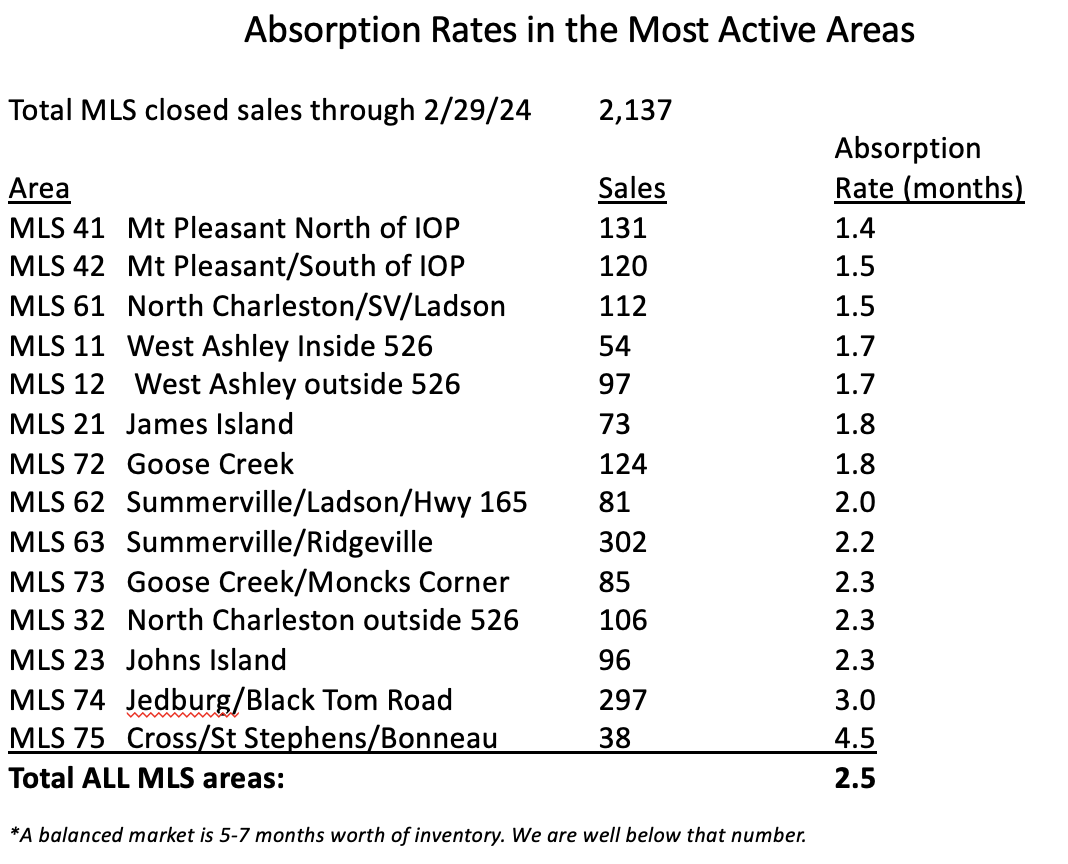
Here are the latest stats from Charleston Metro MLS – February 2024 calculations.
The median sales price for the Charleston Market has remained fairly steady with a median a sales price of $407,235. up about 6% above February 2023.
While the median sales price has remained in a tight band, between 400k-420k, for most of the previous 24 months, the seasonal dip in median price that is typically experienced around the first of the year bottomed out about 6% above last year’s seasonal dip (2/2023 vs 2/2024), suggesting that the current pricing in our market has a solid base and given low inventory levels relative to sales levels, this could mean that additional price gains lie ahead.
The inventory calculated at February’s end was at 2.5 months, which is an increase over last February’s 1.76 months.
Active Inventory stands at approximately 2,900 listings. While this level of inventory is a significant increase from the low of last February, but we still need roughly 3,500 additional listings market wide to achieve a balanced market (5 months of inventory)
The average days on market was calculated at 48 (median was 25) at February’s end.
Although inventory is low, we have recently had an increase in new listings coming onto the market.
New listings taken have gone up dramatically over the past sixty days with more than 2,000 new listings coming online in February, +36% to the number of listings taken last February. This should help drive sales this spring and summer.
1287 sold properties in February 2024, up 11.6 % from last February’s but written sales, market wide, was down -4%.
Last week saw 291 properties go under contract.
New construction represents 41% of all pending contracts in the MLS and new construction comprises about 35% of the closings.
Foreclosures and Short Sales continue to hold at a combined .7% of all available listings currently. This is down from 1.8% of all available listings on 1/1/2020. There are very few “newly distressed” properties in the pipeline.
Surprisingly, we are at roughly double the monthly pre-pandemic sales levels of properties over one million. This market segment remains surprisingly robust.
Keep in mind, this is a snapshot of the entire Metro Market, real estate is hyper-local and stats will vary within the different areas of the market. If you would like information about your property or neighborhood, please don’t hesitate to contact me.
Wondering if it still makes sense to sell your house right now? Everyone’s situation is unique, but the current market could prove to be beneficial for you.
An article from Calculated Risk shows there are 15.6% more homes for sale now, nationally, compared to the same week last year. That tells us inventory has grown. But going back to 2019, the last normal year in the housing market, there are nearly 40% fewer homes available now:
How this could benefit you when you sell.
1. You Have More Options for Your Move
If you are going to move to another home, the year-over-year growth gives you more options for your home search. This means it may be a little less of a challenge to find what you’re looking for.
2. You Still Won’t Have as Much Competition When You Sell
Even though there are more homes for sale now, there still aren’t as many as there’d be in a normal year. Remember, the data from Calculated Risk shows we’re down nearly 40% compared to 2019. And that large a deficit won’t be solved overnight. As a recent article from Realtor.comexplains:
“. . . the number of homes for sale and new listing activity continues to improve compared to last year. However the inventory of homes for sale still has a long journey back to pre-pandemic levels.”
Less competition means you may find an eager buyer quickly and get your home sold for top dollar.
Bottom Line
So, If you’re a looking to make a move, NOW could prove to be a great time! You’ll have more options when buying your next home than you did last year, and there’s not a ton of competition from other sellers.
If you have considered selling, I would be happy to provide you with information and resources to help you determine if the timing is right for you to make a move.
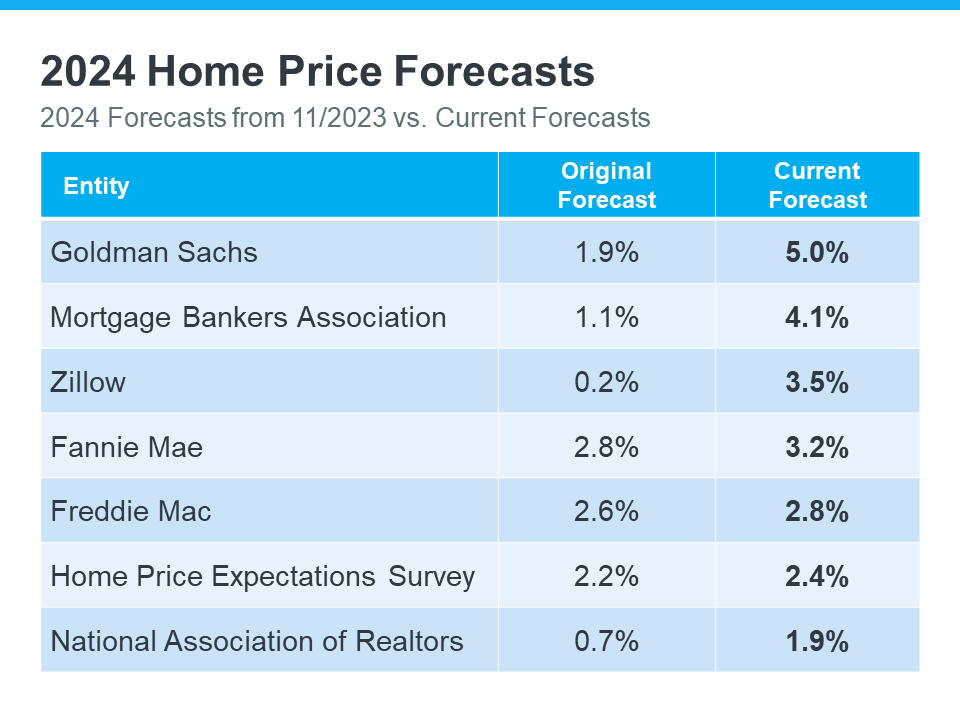
Over the past few months, experts have revised their 2024 home price forecasts based on the latest data and market signals, and they’re even more confident prices will rise, not fall.
What’s caused the change?
2024 Home Price Forecasts: Then and Now
The chart below shows what seven expert organizations think will happen to home prices in 2024. It compares their first 2024 home price forecasts (made at the end of 2023) with their newest projections:
The middle column shows that, at first, these experts thought home prices would only go up a little this year. But if you look at the column on the right, you’ll see they’ve all updated their forecasts and now think prices will go up more than they originally thought. And some of the differences are major.
There are two big factors keeping such strong upward pressure on home prices. The first is how few homes are for sale right now. According to Business Insider:
“Low home inventory is a chronic problem in the US. This has generally kept home prices up . . .”
A lack of housing inventory has been pushing prices up for a long time now – and that’s not expected to change dramatically this year. But what has changed a bit is mortgage rates.
Late last year when most housing market experts were calling for home prices to rise only a little bit in 2024, mortgage rates were up and buyer demand was more moderate.
Now that rates have come down from their peak last October, and with further declines expected over the course of the year, buyer demand has picked up. That increase in demand, along with an ongoing lack of inventory, is what’s caused the experts to feel the upward pressure on prices will be stronger than they expected a couple months ago.
A Look Forward To Get Ahead of the Next Forecast Revisions
Real estate experts regularly revise their home price forecasts as the housing market shifts. It’s a normal part of their job that ensures their projections are always up-to-date and factor in the latest changes in the housing market.
That means they’ll continue to revise their projections as the housing market changes, just as they’ve always done. How those forecasts change next is anyone’s guess but pay attention to mortgage rates.
If they trend down as the year goes on, as they’re expected to do, that could lead to more buyer demand and even higher home price forecasts.
Basically, it’s all about supply and demand. With supply still so limited, anything that causes demand to go up will likely cause prices to go up, too.
Bottom Line
At first, experts believed home prices would only go up a little this year. But now, they’ve changed their minds and are forecasting that prices will grow even more than they originally thought.
If you have considered buying or selling a home this year, I would love to help! Please feel free to contact me.