Category Archives: Home Buying (For Buyers)

This category features information about buying property.

Mortgage Rates take a slight dip but Where are They Headed?

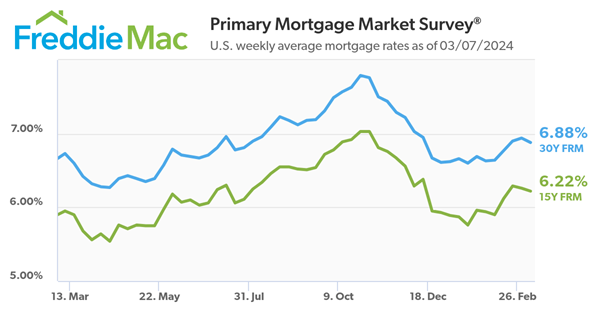
Freddie Mac reports the 30-year FRM averaged 6.88 percent as of March 7, 2024, down from last week when it averaged 6.94 percent. A year ago, at this time, the 30-year FRM averaged 6.73 percent.

As the rates took a small dip, mortgage applications rose, evidence that purchase demand remains sensitive to interest rate changes. Mortgage rates continue to be one of the biggest hurdles for potential homebuyers looking to enter the market.

SEE FREDDIE MAC RATE AVERAGES HERE
Where are Rates Headed? No one has a crystal ball but here is what some experts are predicting:

  • Freddie Mac. With the current stance of monetary policy holding steady, we expect mortgage rates to move sideways, remaining above 6.5% through this quarter and drifting down to about 6% by year’s end.
    Fannie Mae Housing Forecast. The 30-year fixed rate mortgage will average 6.3% in Q2 2024 and slowly decline over the year, landing at a Q4 average of 5.9%.
  • National Association of Realtors chief economist Lawrence Yun. “The budget deficit remains high, and the various inflation metrics remain above the comfort level. That means the mortgage rates will likely be in the 6% to 7% range for most of the year.”
  • Mortgage Bankers Association (MBA). MBA’s baseline forecast is for mortgage rates to end 2024 at 6.1% and reach 5.5% at the end of 2025 as Treasury rates decline and the spread narrows.
  • Bright MLS chief economist Dr. Lisa Sturtevant. During the early part of the year, expect some bumpiness in rates as new economic data are released and as more buyers get back into the market. However, the overall outlook for mortgage rates in 2024 suggests more rate drops, with Bright MLS forecasts predicting rates to hit 6.2% by the fourth quarter.

If you are considering buying a home and would like help navigating through the process, feel free to contact me.

Gena Glaze

Leave a comment

Filed under Home Buying (For Buyers), Real Estate (Market info)

Expert Home Price Forecasts for 2024 Revised Up

Over the past few months, experts have revised their 2024 home price forecasts based on the latest data and market signals, and they’re even more confident prices will rise, not fall.

What’s caused the change?

2024 Home Price Forecasts: Then and Now

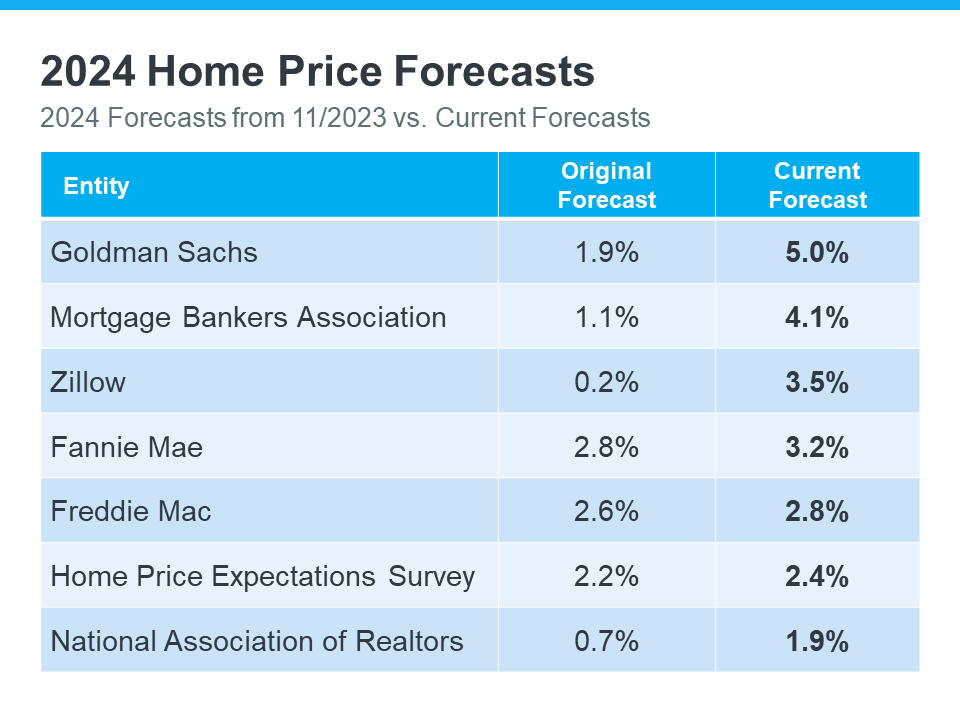
The chart below shows what seven expert organizations think will happen to home prices in 2024. It compares their first 2024 home price forecasts (made at the end of 2023) with their newest projections:

a blue and white graph with text

The middle column shows that, at first, these experts thought home prices would only go up a little this year. But if you look at the column on the right, you’ll see they’ve all updated their forecasts and now think prices will go up more than they originally thought. And some of the differences are major.

There are two big factors keeping such strong upward pressure on home prices. The first is how few homes are for sale right now. According to Business Insider:

Low home inventory is a chronic problem in the US. This has generally kept home prices up . . .”

A lack of housing inventory has been pushing prices up for a long time now – and that’s not expected to change dramatically this year. But what has changed a bit is mortgage rates.

Late last year when most housing market experts were calling for home prices to rise only a little bit in 2024, mortgage rates were up and buyer demand was more moderate.

Now that rates have come down from their peak last October, and with further declines expected over the course of the year, buyer demand has picked up. That increase in demand, along with an ongoing lack of inventory, is what’s caused the experts to feel the upward pressure on prices will be stronger than they expected a couple months ago.

A Look Forward To Get Ahead of the Next Forecast Revisions

Real estate experts regularly revise their home price forecasts as the housing market shifts. It’s a normal part of their job that ensures their projections are always up-to-date and factor in the latest changes in the housing market.

That means they’ll continue to revise their projections as the housing market changes, just as they’ve always done. How those forecasts change next is anyone’s guess but pay attention to mortgage rates.

If they trend down as the year goes on, as they’re expected to do, that could lead to more buyer demand and even higher home price forecasts.

Basically, it’s all about supply and demand. With supply still so limited, anything that causes demand to go up will likely cause prices to go up, too.

Bottom Line

At first, experts believed home prices would only go up a little this year. But now, they’ve changed their minds and are forecasting that prices will grow even more than they originally thought.

If you have considered buying or selling a home this year, I would love to help! Please feel free to contact me.
Gena Glaze

Leave a comment

Filed under Home Buying (For Buyers), Market Statistics, Real Estate (Market info), Selling Real Estate (For Sellers)

Why People Fall in Love with Homeownership

Chances are at some point in your life you’ve heard the phrase, home is where the heart is. There’s a reason that’s said so often. Becoming a homeowner is emotional.

So, if you’re trying to decide if you want to keep on renting or if you’re ready to buy a home this year, here’s why it’s so easy to fall in love with homeownership.

Customizing to Your Heart’s Desire

Your house should be a space that’s uniquely you. And, if you’re a renter, that can be hard to achieve. When you rent, you don’t have much control over the upgrades, and you’ve got to be careful how many holes you put in the walls. But when you’re a homeowner, you have a lot more freedom. As the National Association of Realtors (NAR) says:

“The home is yours. You can decorate any way you want and choose the types of upgrades and new amenities that appeal to your lifestyle.”

Whether you want to paint the walls a cheery bright color or go for a dark moody tone, you can match your interior to your vibe. Imagine how it would feel to come home at the end of the day and walk into a space that feels like you.

Greater Stability for the Ones You Love Most

One of the hardest things about renting is the uncertainty of what happens at the end of your lease. Does your payment go up so much that you have to move? What if your landlord decides to sell the property? It’s like you’re always waiting for the other shoe to drop. Jeff Ostrowski, a business journalist covering real estate and the economy, explains how homeownership can give you more peace of mind in a Money Geek article:

“Homeownership means you are the boss and have the biggest say in your lifestyle and family decisions. Suppose your kids are in public school and you don’t want to risk having them change schools because your landlord doesn’t renew your lease. Owning a home would remove much of the risk of having to move.”

A Feeling of Belonging

You may also find you feel much more at home in the community once you own a house. That’s because, when you buy a home, you’re staking a claim and saying, I’m a part of this community. You’ll have neighbors, block parties, and more. And that’ll give you the feeling of being a part of something bigger. As the International Housing Association explains:

“. . . homeowning households are more socially involved in community affairs than their renting counterparts. This is due to both the fact that homeowners expect to remain in the community for a longer period of time and that homeowners have an ownership stake in the neighborhood.”

The Emotional High of Achieving Your Dream

You’ll be able to walk up to your front door every day and have that sense of accomplishment welcome you home. 

Overview of Benefits – Published by NAR

  1. Appreciation. Historically, real estate has had long-term, stable growth in value and served as a good hedge against inflation. Census data shows the median price of a home jumped from $172,900 in Q4 2000 to $417,700 in Q4 2023. That’s greater than 6% appreciation per year on average.
  2. Equity. Money paid for rent is money that you’ll never see again, but paying your mortgage month over month and year over year lets you build equity ownership interest in your home.
  3. Tax benefits. If you itemize deductions on your federal tax return, the U.S. Tax Code lets you deduct the interest you pay on your mortgage, your property taxes (up to $10,000 according to current tax law), and some of the costs involved in buying a home. Be sure to talk to your accountant to see if it’s advantageous for you to itemize.
  4. Savings. Building equity in your home is a ready-made savings plan. And when you sell, you can generally exclude up to $250,000 ($500,000 for a married couple) of gain without owing any federal income tax. The IRS provide guidance(link is external) on how to qualify for the exclusion.
  5. Predictability. Unlike rent, your fixed-rate mortgage payments don’t rise from year to year. So, as a percentage of your income, your housing costs may actually decline over time. However, keep in mind that property taxes and insurance costs may increase.
  6. Freedom. The home is yours. You can decorate any way you want and choose the types of upgrades and new amenities that appeal to your lifestyle.
  7. Stability. Remaining in one neighborhood for several years allows you and your family time to build long-lasting relationships within the community. It also offers children the benefit of educational and social continuity.

A home is a place that reflects who you are, a safe space for the ones you love the most, and a reflection of all you’ve accomplished.

Let’s connect if you’re ready to buy or sell a home!

Leave a comment

Filed under Home Buying (For Buyers), People, Stories, News & Events

What’s Really Happening with Mortgage Rates?

Are you feeling a bit unsure about what’s really happening with mortgage rates? That might be because you’ve heard they’re coming down. But then you read somewhere else that they’re up again. And that may leave you scratching your head and wondering what’s true.

The simplest answer is: that what you read or hear will vary based on the time frame they’re looking at. Here’s some information that can help clear up the confusion.

Mortgage Rates Are Volatile by Nature

Mortgage rates don’t move in a straight line. There are too many factors at play for that to happen. Instead, rates bounce around because they’re impacted by things like economic conditions, decisions from the Federal Reserve, and so much more. That means they might be up one day and down the next depending on what’s going on in the economy and the world as a whole.

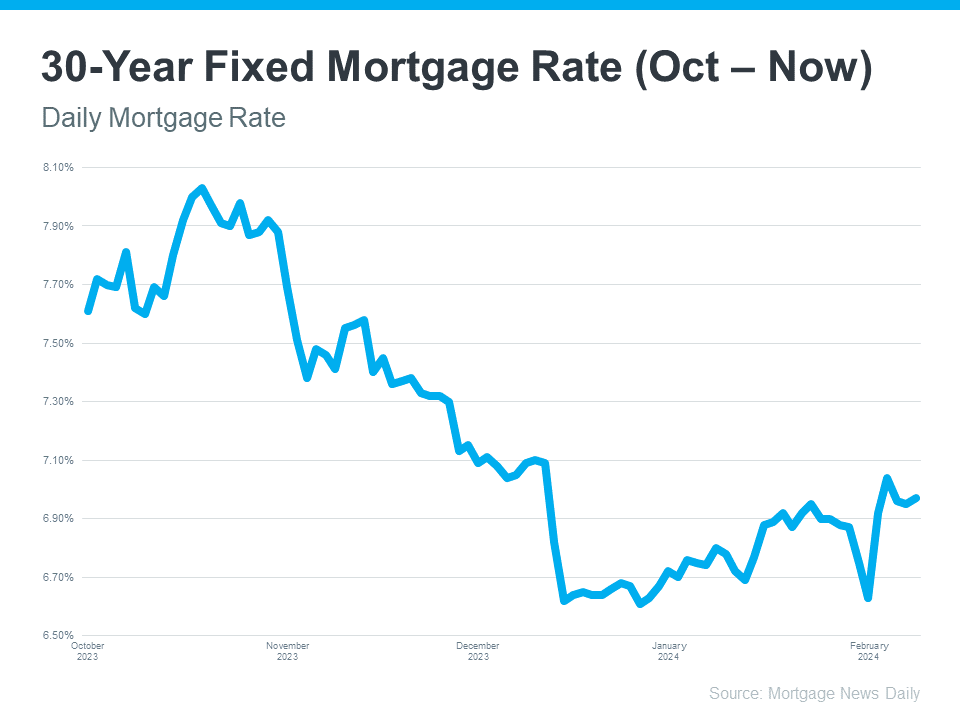
Take a look at the graph below. It uses data from Mortgage News Daily to show the ebbs and flows in the 30-year fixed mortgage rate since last October:

If you look at the graph, you’ll see a lot of peaks and valleys – some bigger than others. And when you use data like this to explain what’s happening, the story can be different based on which two points in the graph you’re comparing.

For example, if you’re only looking at the beginning of this month through now, you may think mortgage rates are on the way back up. But, if you look at the latest data point and compare it to the peak in October, rates have trended down. So, what’s the right way to look at it?

The Big Picture

Mortgage rates are always going to bounce around. It’s just how they work. So, you shouldn’t focus too much on the small, daily changes. Instead, to really understand the overall trend, zoom out and look at the big picture.

When you look at the highest point (October) compared to where rates are now, you can see they’ve come down compared to last year. And if you’re looking to buy a home, this is big news. Don’t let the little blips distract you. The experts agree, overall, that the larger downward trend could continue this year. 

Despite the ups and downs, many analysists predict mortgage rates will, over-all, move in a slow declining path as the year progresses, but many factors can influence the trajectory and so only time will tell.

Check current rates at Freddie Mac

Gena Glaze

Leave a comment

Filed under Home Buying (For Buyers), Mortgage Info

Capital Gains Tax and Exclusions.

A capital gain is the profit made when selling an investment or asset, including real estate. The capital gains tax is the levy on that profit when an investment is sold. It is owed for the tax year during which the investment is sold.

Long-term capital gains tax is the tax levied on profits of an asset or investment that was owned for over one year. The long-term capital gains tax rate vary and depend on your income but the rates are typically lower than your ordinary income tax rate

If the investment or asset is owned for less than a year when the gain is made, then the  short-term capital gains tax applies. The short-term rate is typically determined by the taxpayer’s ordinary income bracket – but can vary in some circumstances.

The Primary Residence Exclusion. IRS – Section 121

The Internal Revenue Service (IRS) allows homeowners to exclude a certain amount of gains that result from the sale of their primary home from their income. This is known as the Section 121 rule.

Single Homeowners may exclude up to $250,000 of gains on the sale of their property, and married homeowners filing jointly can exclude up to $500,000.

To be eligible for these exclusions You must have owned the home for at least two years AND have lived in the home as your primary residence for at least two years of the previous five years prior to the sale date. The two-year period does not have to be consecutive. See More Here at IRS

Investment Property Deferment- 1031 Tax Exchange in Real Estate

Section 1031 is a provision of the Internal Revenue Code (IRC) that allows a businesses or the owners of investment property to defer federal taxes on some exchanges of real estate.  The provision is used by investors who are selling one property and reinvesting the proceeds in one or more other properties.

Qualifying Section 1031 exchanges are called 1031 exchanges, or like-kind exchanges.

In General, A 1031 exchange allows investors to defer taxes on the profits of sold investments. The exchange can be complex with rigid time frames for identifying the replacement property and reqiures a Qualified Intermediary (QI) to oversee and process and the funds.

Tax laws and codes are complex and can change, always consult a tax professional to review your unique situation.

More Info at IRS

Gena Glaze

Leave a comment

Filed under Home Buying (For Buyers), Learn Real Estate Terms, Real Estate (Market info), Selling Real Estate (For Sellers)

What Influences Mortgage Rates? 2024

2 of the Factors That Impact Mortgage Rates

if you’re looking to buy a home, you’ve probably been paying close attention to mortgage rates. Over the last couple of years, they hit record lows, rose dramatically, and are now dropping back down a bit. Ever wonder why?

The answer is complicated because there’s a lot that can influence mortgage rates. Here are just a few of the most impactful factors at play.

Inflation and the Federal Reserve

The Federal Reserve (Fed) doesn’t directly determine mortgage rates. But the Fed does move the Federal Funds Rate up or down in response to what’s happening with inflation, the economy, employment rates, and more. As that happens, mortgage rates tend to respond. Business Insider explains:

The Federal Reserve slows inflation by raising the federal funds rate, which can indirectly impact mortgages. High inflation and investor expectations of more Fed rate hikes can push mortgage rates up. If investors believe the Fed may cut rates and inflation is decelerating, mortgage rates will typically trend down.”

Over the last couple of years, the Fed raised the Federal Fund Rate to try to fight inflation and, as that happened, mortgage rates jumped up, too. Fortunately, the expert outlook for inflation and mortgage rates is that both should become more favorable over the course of the year. As Danielle Hale, Chief Economist at Realtor.comsays:

“[Mortgage rates will continue to ease in 2024 as inflation improves . . .”

There’s even talk the Fed may actually cut the Fed Funds Rate this year because inflation is cooling, even though it’s not yet back to their ideal target.

The 10-Year Treasury Yield

Additionally, mortgage companies look at the 10-Year Treasury Yield to decide how much interest to charge on home loans. If the yield goes up, mortgage rates usually go up, too. The opposite is also true. According to Investopedia:

“One frequently used government bond benchmark to which mortgage lenders often peg their interest rates is the 10-year Treasury bond yield.”

Historically, the spread between the 10-Year Treasury Yield and the 30-year fixed mortgage rate has been fairly consistent, but that’s not the case recently. That means, there’s room for mortgage rates to come down. So, keeping an eye on which way the treasury yield is trending can give experts an idea of where mortgage rates may head next.

Bottom Line

With the Fed meets, experts in the industry will be keeping a close watch to see what they decide and what impact it’ll have on the economy.

Gena Glaze

Leave a comment

Filed under Home Buying (For Buyers), Mortgage Info

30-year Mortgage Rates Remain Below 7% – Increasing Buyers Purchasing Power

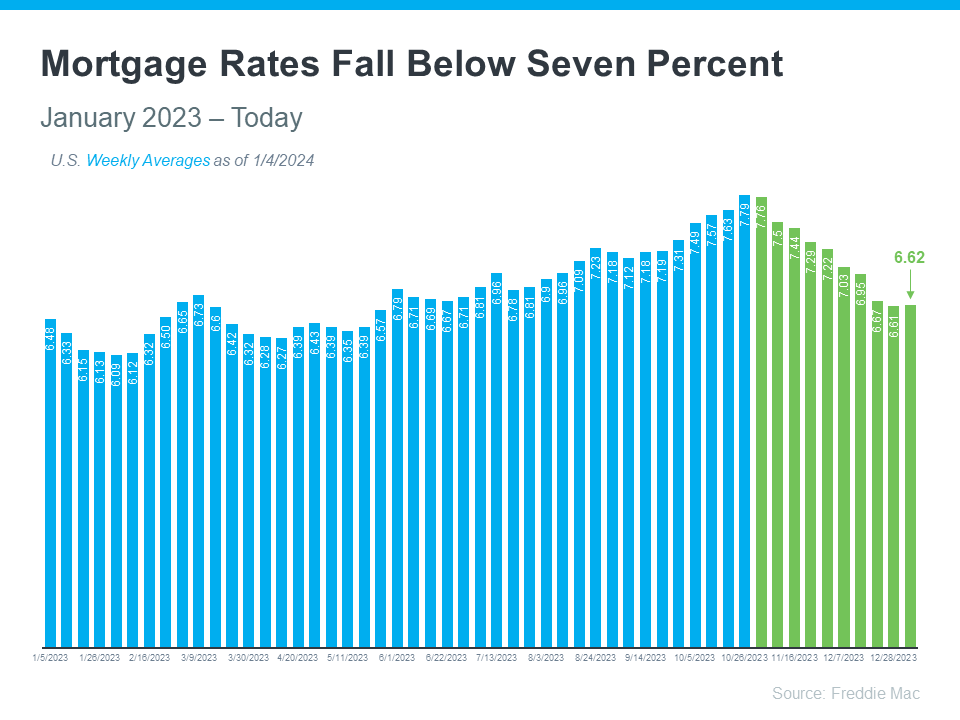
If you want to buy a home, it’s important to know how mortgage rates impact what you can afford and how much you’ll pay each month. Fortunately, rates for 30-year fixed mortgages have come down significantly since the end of October and are currently under 7%, according to Freddie Mac (see graph below) and many analysts predict a continued easing of mortgages rates throughout 2024.

This recent trend is great news for buyers. As a recent article from Bankrate says:

“The rate cool-off somewhat eases the housing affordability squeeze.”

And according to Edward Seiler, AVP of Housing Economics and Executive Director of the Research Institute for Housing America at the Mortgage Bankers Association (MBA):

“MBA expects that affordability conditions will continue to improve as mortgage rates decline . . .”

Here’s a bit more context on how this could help with your plans to buy a home.

How Mortgage Rates Affect Your Search for a Home

Understanding the connection between mortgage rates and your monthly home payment is crucial for understanding the sales price you can afford. The chart below illustrates how your ability to afford a home changes when mortgage rates shift. (see chart below):

More information about interest rates at Freddie Mac

Gena Glaze

Leave a comment

Filed under Home Buying (For Buyers), Mortgage Info

South Carolina Named the Fastest Growing State in the Nation

Newcomers to S.C. greatly accelerated during the pandemic years as remote employment took hold and that trend has continued. South Carolina was recently crowned the fastest-growing state in the nation by the U.S. Census Bureau based on percentage growth, adding roughly 90,000 additional residents to the population.

Top 10 States or State Equivalent by Percent Growth: 2022 to 2023
RankGeographic AreaApril 1, 2020 (Estimates Base)July 1, 2022July 1, 2023Percent Growth
1South Carolina5,118,4225,282,9555,373,5551.7
2Florida21,538,21622,245,52122,610,7261.6
3Texas29,145,45930,029,84830,503,3011.6
4Idaho1,839,1171,938,9961,964,7261.3
5North Carolina10,439,45910,695,96510,835,4911.3
6Delaware989,9461,019,4591,031,8901.2
7District of Columbia689,548670,949678,9721.2
8Tennessee6,910,7867,048,9767,126,4891.1
9Utah3,271,6143,381,2363,417,7341.1
10Georgia10,713,77110,913,15011,029,2271.1

This population boom created more demand for housing, but inventory has been constrained, keeping prices afloat and putting pressures on rents.

The population growth is mainly concentrated in larger cities with populations declining in some rural areas. Local governments increasingly engage in managing growth and pursuing affordable housing options for workforce.

Mortgage interest rates have fallen from their peak of nearly 8 percent in 2023, and many financial experts speculate interest rates will continue to moderate. Inventory is expected to rise, and lower interest rates should help make homes more affordable. Whether the rising supply can keep up with demand remains to be seen.

Gena Glaze

More information: at

Post and Courier

Census Bureau

Leave a comment

Filed under Charleston Area Growth and Development, Home Buying (For Buyers), Real Estate (Market info), Selling Real Estate (For Sellers)

2023 – A Year In Review – Charleston Area Real Estate SC

Seasonal Flow of Business Returns. We seem to have exited the “pandemic years” when real estate was busy at all points in the year and we have returned to a more normal seasonal flow of business as shown in the chart below. All three lines (2022, 2023, and the 15 year average) track each other closely throughout the year. The orange line represents ratified contracts by week 2022, the green line is 2023 and the blue line is the 15-year average for each week.

As inventory was still constrained and interest rates begin retreating, written sales market wide finished -7% in December of ’23 versus December of ‘22

 The Median sale price in the Charleston MLS continues to stay in a tight band between $400k and $420k where it has been for most of the last 20 months.

Inventory remained below what is needed for a balanced market throughout 2023.         At end of December active Inventory stood at approximately 2,800 listings. This level of inventory is a significant increase over the 1,035 listing “floor” that we set in February of 2022, but still below what is needed for a balanced market.  3,000 additional listings are needed market wide to achieve a balanced market (5 months of inventory)

The gap between the number of listings available for sale and the number of listings needed to maintain a balanced market is expressed visually in the chart below.

The Good News` – Although inventory is still constrained, we are starting to see a trend of new listings hitting the market increasing over the same month a year prior for the first time in two years. This has happened for three consecutive months.

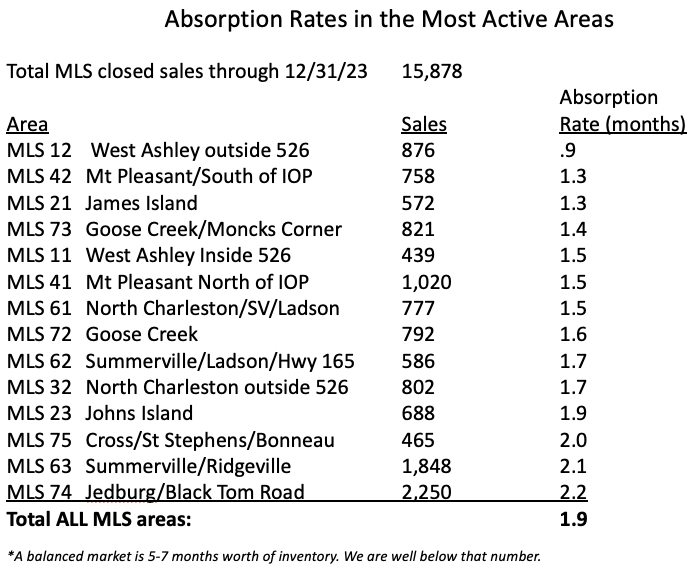
Absorption Rate                                       By the end of the 2023, The Charleston market had about eight weeks of inventory as a whole, still trending more toward a seller’s market (this can vary by price range and specific location). The most active areas have inventory levels in the 5–9-week range.

New Construction                                       At December’s end, new construction represented approximately 49% of pending contracts in the MLS and new construction comprised about 33% of the closings and new homes represented approximately 32% of the available inventory.

Looking forward for what 2024 will bring!

Gena Glaze

Leave a comment

01/15/2024 · 2:05 pm

What is a 2-1 Buydown?

Sellers, including home builders, will sometimes use 2-1 buydowns as an incentive for potential purchasers

A 2-1 buydown is a concession or incentive negotiated with a seller or builder that temporarily reduces a buyer’s mortgage interest rate by 2 percentage points the first year and 1 percentage point the second year of your mortgage. The third year the interest rate goes back to the fixed rate obtained from the lender.

  • A 2-1 buydown is a type of financing that lowers the interest rate on a mortgage for the first two years before it rises to the regular, permanent rate.
  • The rate is typically two percentage points lower during the first year and one percentage point lower in the second year.
  • Sellers, including home builders, may offer a 2-1 buydown to make a property more attractive to buyers.
  • 2-1 buydowns can be a good deal for homebuyers, provided that they will be able to afford the higher monthly payments once those begin.

Lenders charge an additional fee to make up for the interest that they won’t be receiving in those early years. A homebuyer or seller can pay for a buydown. That payment may be in the form of mortgage points, or a lump sum deposited in an escrow account with the lender and used to subsidize the borrower’s reduced monthly payments.

The 2-1 buydown is sometimes offered as an incentive and sometimes it is part of the buyer’s negotiations.

Example

Suppose a new home builder is offering a 2-1 buydown on its new homes. If the prevailing interest rate on 30-year mortgages is 6% for a particular buyer, this homebuyer could get a mortgage that charged just 4% in the first year, then 5% in the second year, and 6% starting in year three and continuing through the remaining years. The reduced payments in those first two years can result in substantial savings.

Gena Glaze

Leave a comment

Filed under Home Buying (For Buyers), Learn Real Estate Terms, Mortgage Info