Nexton, recently announced the addition of Stanley Martin Homes, to the community’s builder program. With plans to develop a collection of townhomes and condos, this project is one of several Stanley Martin developments launching in the Charleston area.
Nexton ranks among the best-selling communities in the nation and boasts a variety of neighborhoods that feature local and national builders and include a diverse array of homes.
Nexton has established itself as a live-work-play destination that features dining, shopping, services and hospitality. Nexton has delivered over 500,000 square feet of office space and offers conveniences such as sought-after schools, grocery stores, modern infrastructure, 20 miles of trails and 2,000 acres of green space.
Over the past few months, experts have revised their 2024 home price forecasts based on the latest data and market signals, and they’re even more confident prices will rise, not fall.
What’s caused the change?
2024 Home Price Forecasts: Then and Now
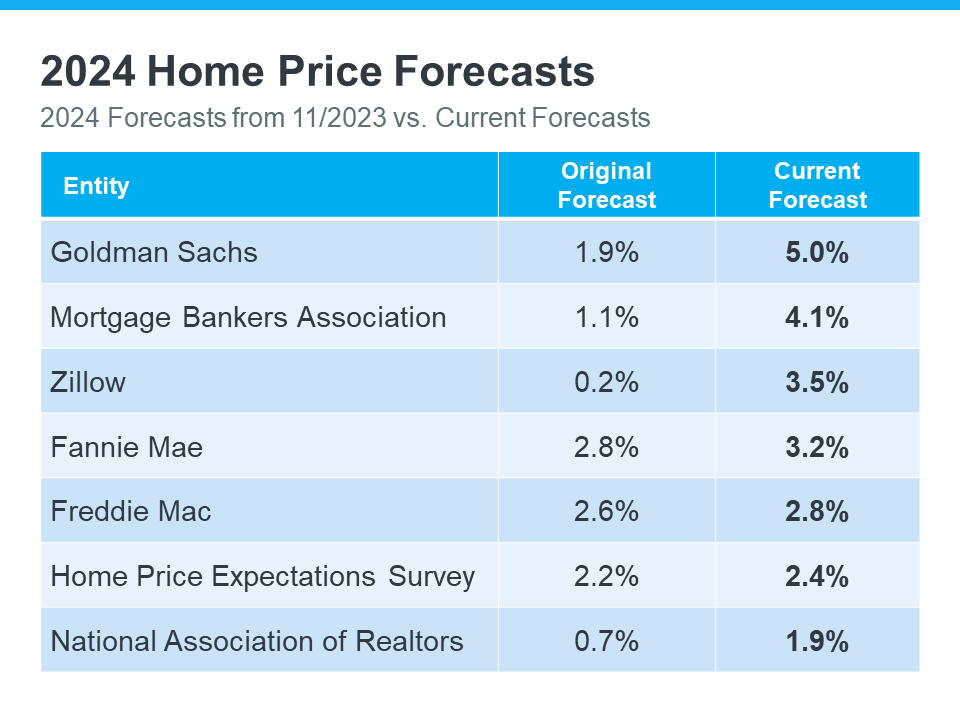
The chart below shows what seven expert organizations think will happen to home prices in 2024. It compares their first 2024 home price forecasts (made at the end of 2023) with their newest projections:
The middle column shows that, at first, these experts thought home prices would only go up a little this year. But if you look at the column on the right, you’ll see they’ve all updated their forecasts and now think prices will go up more than they originally thought. And some of the differences are major.
There are two big factors keeping such strong upward pressure on home prices. The first is how few homes are for sale right now. According to Business Insider:
“Low home inventory is a chronic problem in the US. This has generally kept home prices up . . .”
A lack of housing inventory has been pushing prices up for a long time now – and that’s not expected to change dramatically this year. But what has changed a bit is mortgage rates.
Late last year when most housing market experts were calling for home prices to rise only a little bit in 2024, mortgage rates were up and buyer demand was more moderate.
Now that rates have come down from their peak last October, and with further declines expected over the course of the year, buyer demand has picked up. That increase in demand, along with an ongoing lack of inventory, is what’s caused the experts to feel the upward pressure on prices will be stronger than they expected a couple months ago.
A Look Forward To Get Ahead of the Next Forecast Revisions
Real estate experts regularly revise their home price forecasts as the housing market shifts. It’s a normal part of their job that ensures their projections are always up-to-date and factor in the latest changes in the housing market.
That means they’ll continue to revise their projections as the housing market changes, just as they’ve always done. How those forecasts change next is anyone’s guess but pay attention to mortgage rates.
If they trend down as the year goes on, as they’re expected to do, that could lead to more buyer demand and even higher home price forecasts.
Basically, it’s all about supply and demand. With supply still so limited, anything that causes demand to go up will likely cause prices to go up, too.
Bottom Line
At first, experts believed home prices would only go up a little this year. But now, they’ve changed their minds and are forecasting that prices will grow even more than they originally thought.
If you have considered buying or selling a home this year, I would love to help! Please feel free to contact me.
The $510 million land deal for the undisclosed business that I posted about in October 2023 has been revealed. Internet giant Google confirmed Feb. 15 that it is planning to build a $510 million data center at the Pine Hill Business Campus west of Summerville — the company’s second in the Charleston region.
The project has received historic tax breaks from Dorchester County and a discount electricity deal from Dominion Energy. Google also has not said when it will begin construction or how many jobs it will create at the 231-acre site along Highway 17A.
The Pine Hill data center will join another that the company completed in 2007 at Mount Holly Commerce Park off Highway 52 near Moncks Corner in neighboring Berkeley County.
Google, going by the aliases Project Evergreen and Gannett Enterprises LLC, has also purchased 206 acres for a proposed third data center near the county’s Winding Woods Commerce Park along Highway 78. The company said it only plans to develop the Pine Hill project for now but will hold onto the other land near the town of St. George for potential future needs according to business demands.
The sale of the properties had not been recorded with the Register of Deeds as of Friday (2-16-24)
Members of Dorchester County Council have said the Pine Hill data center is expected to generate about $2 million a year in new revenue and they have praised Google’s community involvement, including providing free laptops to local schools.
Chances are at some point in your life you’ve heard the phrase, home is where the heart is. There’s a reason that’s said so often. Becoming a homeowner is emotional.
So, if you’re trying to decide if you want to keep on renting or if you’re ready to buy a home this year, here’s why it’s so easy to fall in love with homeownership.
Customizing to Your Heart’s Desire
Your house should be a space that’s uniquely you. And, if you’re a renter, that can be hard to achieve. When you rent, you don’t have much control over the upgrades, and you’ve got to be careful how many holes you put in the walls. But when you’re a homeowner, you have a lot more freedom. As the National Association of Realtors (NAR) says:
“The home is yours. You can decorate any way you want and choose the types of upgrades and new amenities that appeal to your lifestyle.”
Whether you want to paint the walls a cheery bright color or go for a dark moody tone, you can match your interior to your vibe. Imagine how it would feel to come home at the end of the day and walk into a space that feels like you.
Greater Stability for the Ones You Love Most
One of the hardest things about renting is the uncertainty of what happens at the end of your lease. Does your payment go up so much that you have to move? What if your landlord decides to sell the property? It’s like you’re always waiting for the other shoe to drop. Jeff Ostrowski, a business journalist covering real estate and the economy, explains how homeownership can give you more peace of mind in a Money Geekarticle:
“Homeownership means you are the boss and have the biggest say in your lifestyle and family decisions. Suppose your kids are in public school and you don’t want to risk having them change schools because your landlord doesn’t renew your lease. Owning a home would remove much of the risk of having to move.”
A Feeling of Belonging
You may also find you feel much more at home in the community once you own a house. That’s because, when you buy a home, you’re staking a claim and saying, I’m a part of this community. You’ll have neighbors, block parties, and more. And that’ll give you the feeling of being a part of something bigger. As the International Housing Association explains:
“. . . homeowning households are more socially involved in community affairs than their renting counterparts. This is due to both the fact that homeowners expect to remain in the community for a longer period of time and that homeowners have an ownership stake in the neighborhood.”
The Emotional High of Achieving Your Dream
You’ll be able to walk up to your front door every day and have that sense of accomplishment welcome you home.
Overview of Benefits – Published by NAR
Appreciation. Historically, real estate has had long-term, stable growth in value and served as a good hedge against inflation. Census data shows the median price of a home jumped from $172,900 in Q4 2000 to $417,700 in Q4 2023. That’s greater than 6% appreciation per year on average.
Equity. Money paid for rent is money that you’ll never see again, but paying your mortgage month over month and year over year lets you build equity ownership interest in your home.
Tax benefits. If you itemize deductions on your federal tax return, the U.S. Tax Code lets you deduct the interest you pay on your mortgage, your property taxes (up to $10,000 according to current tax law), and some of the costs involved in buying a home. Be sure to talk to your accountant to see if it’s advantageous for you to itemize.
Savings. Building equity in your home is a ready-made savings plan. And when you sell, you can generally exclude up to $250,000 ($500,000 for a married couple) of gain without owing any federal income tax. The IRS provide guidance(link is external) on how to qualify for the exclusion.
Predictability. Unlike rent, your fixed-rate mortgage payments don’t rise from year to year. So, as a percentage of your income, your housing costs may actually decline over time. However, keep in mind that property taxes and insurance costs may increase.
Freedom. The home is yours. You can decorate any way you want and choose the types of upgrades and new amenities that appeal to your lifestyle.
Stability. Remaining in one neighborhood for several years allows you and your family time to build long-lasting relationships within the community. It also offers children the benefit of educational and social continuity.
A home is a place that reflects who you are, a safe space for the ones you love the most, and a reflection of all you’ve accomplished.
Let’s connect if you’re ready to buy or sell a home!
Are you feeling a bit unsure about what’s really happening with mortgage rates? That might be because you’ve heard they’re coming down. But then you read somewhere else that they’re up again. And that may leave you scratching your head and wondering what’s true.
The simplest answer is: that what you read or hear will vary based on the time frame they’re looking at. Here’s some information that can help clear up the confusion.
Mortgage Rates Are Volatile by Nature
Mortgage rates don’t move in a straight line. There are too many factors at play for that to happen. Instead, rates bounce around because they’re impacted by things like economic conditions, decisions from the Federal Reserve, and so much more. That means they might be up one day and down the next depending on what’s going on in the economy and the world as a whole.
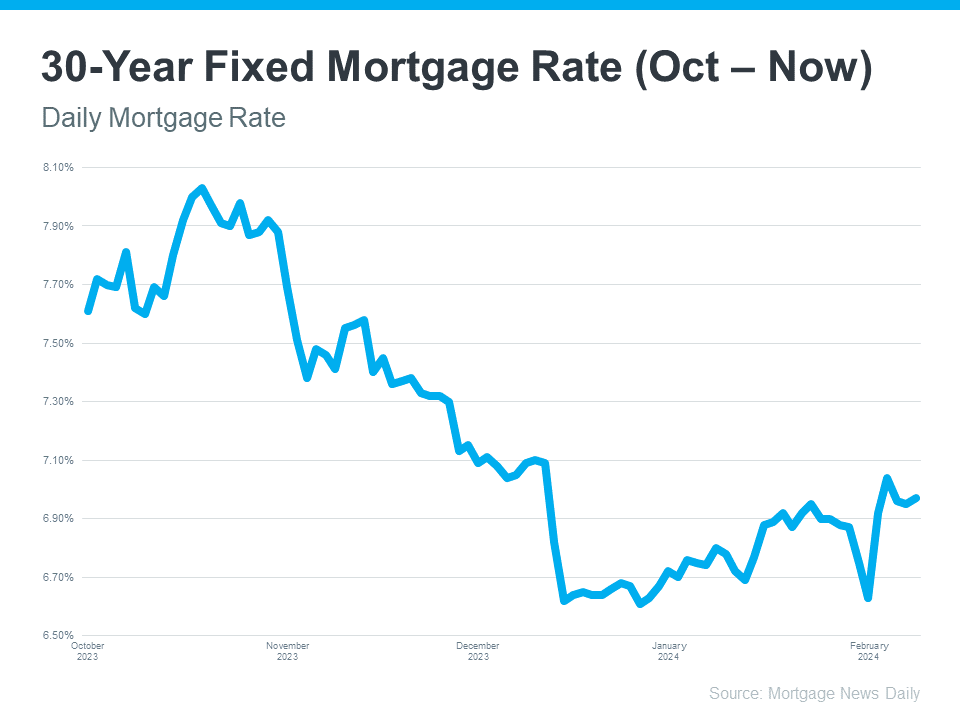
Take a look at the graph below. It uses data from Mortgage News Daily to show the ebbs and flows in the 30-year fixed mortgage rate since last October:
If you look at the graph, you’ll see a lot of peaks and valleys – some bigger than others. And when you use data like this to explain what’s happening, the story can be different based on which two points in the graph you’re comparing.
For example, if you’re only looking at the beginning of this month through now, you may think mortgage rates are on the way back up. But, if you look at the latest data point and compare it to the peak in October, rates have trended down. So, what’s the right way to look at it?
The Big Picture
Mortgage rates are always going to bounce around. It’s just how they work. So, you shouldn’t focus too much on the small, daily changes. Instead, to really understand the overall trend, zoom out and look at the big picture.
When you look at the highest point (October) compared to where rates are now, you can see they’ve come down compared to last year. And if you’re looking to buy a home, this is big news. Don’t let the little blips distract you. The experts agree, overall, that the larger downward trend could continue this year.
Despite the ups and downs, many analysists predict mortgage rates will, over-all, move in a slow declining path as the year progresses, but many factors can influence the trajectory and so only time will tell.
if you’re looking to buy a home, you’ve probably been paying close attention to mortgage rates. Over the last couple of years, they hit record lows, rose dramatically, and are now dropping back down a bit. Ever wonder why?
The answer is complicated because there’s a lot that can influence mortgage rates. Here are just a few of the most impactful factors at play.
Inflation and the Federal Reserve
The Federal Reserve (Fed) doesn’t directly determine mortgage rates. But the Fed does move the Federal Funds Rate up or down in response to what’s happening with inflation, the economy, employment rates, and more. As that happens, mortgage rates tend to respond. Business Insider explains:
“The Federal Reserve slows inflation by raising the federal funds rate, which can indirectly impact mortgages. High inflation and investor expectations of more Fed rate hikes can push mortgage rates up. If investors believe the Fed may cut rates and inflation is decelerating, mortgage rates will typically trend down.”
Over the last couple of years, the Fed raised the Federal Fund Rate to try to fight inflation and, as that happened, mortgage rates jumped up, too. Fortunately, the expert outlook for inflation and mortgage rates is that both should become more favorable over the course of the year. As Danielle Hale, Chief Economist at Realtor.com, says:
“[Mortgage rates will continue to ease in 2024 as inflation improves . . .”
There’s even talk the Fed may actually cut the Fed Funds Rate this year because inflation is cooling, even though it’s not yet back to their ideal target.
The 10-Year Treasury Yield
Additionally, mortgage companies look at the 10-Year Treasury Yield to decide how much interest to charge on home loans. If the yield goes up, mortgage rates usually go up, too. The opposite is also true. According to Investopedia:
“One frequently used government bond benchmark to which mortgage lenders often peg their interest rates is the 10-year Treasury bond yield.”
Historically, the spread between the 10-Year Treasury Yield and the 30-year fixed mortgage rate has been fairly consistent, but that’s not the case recently. That means, there’s room for mortgage rates to come down. So, keeping an eye on which way the treasury yield is trending can give experts an idea of where mortgage rates may head next.
Bottom Line
With the Fed meets, experts in the industry will be keeping a close watch to see what they decide and what impact it’ll have on the economy.
The Federal Reserve held interest rates steady on Wednesday but signaled that rates could fall in the coming months if inflation continues to cool.
He cautioned, however, that the economy remains unpredictable and said the central bank would proceed cautiously. ”The economic outlook is uncertain and we remain highly attentive to inflation risks,” Powell said.
The Fed has been pleasantly surprised by the rapid drop in inflation in recent months. Core prices in December — which exclude food and energy prices — were up just 2.9% from a year ago, according to the Fed’s preferred inflation yardstick. That’s a smaller increase than the 3.2% core inflation rate that Fed officials had projected in December.
If that positive trend continues, the Fed may be able to start cutting interest rates as early as this spring. However, he sounded doubtful about a rate cut at the Fed’s next meeting in March as many investors in Wall Street had hoped for. The comments disappointed investors, with the Dow Jones Industrial Average tumbling 317 points.
Investors are still hopeful about a rate cut in May, with markets putting the likelihood of that at better than 90%.
Sellers, including home builders, will sometimes use 2-1 buydowns as an incentive for potential purchasers
A 2-1 buydown is a concession or incentive negotiated with a seller or builder that temporarily reduces a buyer’s mortgage interest rate by 2 percentage points the first year and 1 percentage point the second year of your mortgage. The third year the interest rate goes back to the fixed rate obtained from the lender.
A 2-1 buydown is a type of financing that lowers the interest rate on a mortgage for the first two years before it rises to the regular, permanent rate.
The rate is typically two percentage points lower during the first year and one percentage point lower in the second year.
Sellers, including home builders, may offer a 2-1 buydown to make a property more attractive to buyers.
2-1 buydowns can be a good deal for homebuyers, provided that they will be able to afford the higher monthly payments once those begin.
Lenders charge an additional fee to make up for the interest that they won’t be receiving in those early years. A homebuyer or seller can pay for a buydown. That payment may be in the form of mortgage points, or a lump sum deposited in an escrow account with the lender and used to subsidize the borrower’s reduced monthly payments.
The 2-1 buydown is sometimes offered as an incentive and sometimes it is part of the buyer’s negotiations.
Example
Suppose a new home builder is offering a 2-1 buydown on its new homes. If the prevailing interest rate on 30-year mortgages is 6% for a particular buyer, this homebuyer could get a mortgage that charged just 4% in the first year, then 5% in the second year, and 6% starting in year three and continuing through the remaining years. The reduced payments in those first two years can result in substantial savings.
The 30-year fixed-rate mortgage (FRM) decreased for the sixth straight week, from last week to an average of 7.03% this week, according to the latest Primary Mortgage Market Survey® (PMMS®) from Freddie Mac released Thursday.
This week’s numbers:
30-year fixed-rate mortgage averaged 7.03%, down from last week when it averaged 7.22%. A year ago at this time, the 30-year FRM averaged 6.33%.
15-year fixed-rate mortgage averaged 6.29%, down from last week when it averaged 6.56%. A year ago at this time, the 15-year FRM averaged 5.67%.
Realtor.com Economist Jiayi Xu commented: “The Freddie Mac fixed rate for a 30-year mortgage continued its downward trend to 7.03 percent this week, down from 7.22 percent last week. While Fed Chair Powell stated last Friday that it was too early to conclude that the current monetary policy is restrictive enough to tame inflation down to the 2% target, the cooling October job openings data, a measure of labor demand, released on Tuesday, boosted investors’ confidence that the Federal Reserve was probably done with rate hikes. As a result, the 10-year treasury yield dropped to its lowest level in three months. Looking ahead, we predict that sustained improvement in inflation will bring the mortgage rate down to 6.5% by the end of 2024.
Tax credit: These are dollar-for-dollar reductions on your tax bill. When you claim a tax credit, the amount you owe goes down the exact same dollar amount.
Tax incentive: These encourage taxpayers to do something, like install efficient appliances, in exchange for a tax reduction.
Tax refund: You’re probably familiar with this one already. You’ll get a refund if you pay more in taxes — say, through your paycheck withholdings — than you actually owe.
Tax rebate: These are retroactive tax decreases. Unlike refunds, they can come at any time of year. Rebates are often offered to stimulate the economy, because people tend to spend them immediately.
Tax break: A general term referring to various tax benefits. These could be credits, deductions, exemptions and others.
Tax benefit: Similar to a tax break, these lower your tax liability.
Home improvement tax deduction: Qualifying improvements to your home that qualify for tax deductions.
Most home improvements, like putting on a new roof or performing routine maintenance, don’t qualify for any immediate tax breaks. However, some (known as capital improvements) may raise the value of your home. In that case, you may see a benefit when you sell.
For immediate benefits, check out these incentives that will reduce your 2023 taxes:
Energy efficiency tax credits
Reducing energy consumption saves money and natural resources. The IRA includes multiple clean energy tax credits to help you do both.
Heat pumps: Your air conditioning and furnace are two of the biggest energy users in your home. Switching to an energy efficient heat pump can net you a 30% credit, up to $2,000.
Windows and doors: Replacing leaky doors and windows brings a 30% credit on the cost, up from 10% last year. Credits are capped at $600 for windows and $500 for two doors.
Electrical upgrades: If you need to update your electrical panel to handle new appliances, the government will pay 30%, up to $600.
Home energy audit: To get the most out of these tax incentives, start with a home energy audit. A credit of up to $150 offsets the cost.
Don’t stop there. “[I]incentives on items like solar, energy storage, EVs [electric vehicles] and more are incredibly generous,” says Greg Fasullo, CEO of Elevation, a residential clean technology company.
Installing solar panels gets you a 30% credit. Depending on the size of the project, Fasullo predicts you could save $6,000, based on the average rooftop solar installation cost of $20,000.
Home office tax deduction
Working from home since the pandemic? Fifty-eight percent of American workers are, too, at least part of the time.
If you use a portion of your home exclusively for business purposes, “you may be able to deduct a portion of your mortgage interest, property taxes, and other expenses related to that space,” says Seth Diener, a private wealth manager at Diener Money Management.
The Internal Revenue Service (IRS) has specific rules about what qualifies as a home office, though. If you’re doing Zoom calls from the kitchen table where you eat dinner every night, that doesn’t count. You must have a separate room or area that’s only used for your home office. If that’s you, you can calculate this deduction two ways:
Regular method: Figure out the percentage of your home you use for work. The deduction you can claim is based on this number, and whether your expenses are direct or indirect.
Simplified method: Calculate the square footage of your home office and multiply it by $5 per sq. ft., up to 300 sq. ft., with a maximum deduction of $1,500.
Medical improvements
“If you have medical upgrades that are prescribed by a doctor, such as wheelchair ramps or other accessibility features, these may be deductible as medical expenses,” says Andrew Latham, a certified financial planner and director of content at SuperMoney.com.
The IRS website offers a non-exhaustive list of qualifying capital expenses, including widening doorways, moving electrical devices, adding handrails and grading the exterior.
Note: If the medical home improvement raises the value of your home, the deduction will be based on the difference between the cost of the improvement and the increase in property value.
Rental property investments
Improvements to rental properties fall under a deduction called depreciation.
“Improvements to a rental property are usually considered deductible business expenses,” Latham says. “However, these incentives are subject to specific rules and limits, so it’s advisable to check current tax laws or consult with a tax professional.”
Federal vs. State Home Improvement Tax Incentives
What if you put in that heat pump and got back $2,000 from the federal government? Could you also claim the credit on your state return?
“Yes, in some instances, you can qualify for multiple tax breaks for the same project,” Latham says. “[I]f you install a new energy-efficient heat pump, you might be eligible for a federal tax credit, a state-level incentive, and potentially a rebate from your local utility company.”
Always check with a tax professional for advice as rules and laws change.









 Real Estate Matters in Charleston SC - Gena Glaze