Tag Archives: history

Covenants, Conditions, and Restrictions

Covenants, Conditions, and Restrictions (CCRs) are legal documents in real estate, common in planned communities and subdivisions. These recorded rules govern land use and development, establishing a framework for how properties within a specific area can be utilized. CCRs maintain community standards and can help preserve property value to  ensure individual property use aligns with the neighborhood’s collective vision.

“Covenants” are promises by property owners to perform or refrain from specific actions, such as maintaining a home’s exterior or adhering to landscaping guidelines. “Conditions” are requirements for property ownership, often relating to improvements or obtaining approval for changes. “Restrictions” impose limitations on property use, which might include prohibitions on commercial activities or specific vehicle parking.

Common CCR’s

CCRs include rules and regulations for community standards. Architectural guidelines cover things like exterior paint colors, fencing materials, and home additions. Landscaping rules focus on lawn care, tree removal, and approved plant types. Pet restrictions might limit the number, size, or breed of animals and often include waste disposal requirements.

Parking rules may govern where vehicles can be parked, prohibit oversized vehicles or limit street parking. Limitations on property use, such as commercial businesses from operating from a residence or restricting short-term rentals could also be included in CCR’s.

Establishment and Enforcement

CCRs come into existence through a formal process, typically initiated by the developer of a planned community or subdivision. These documents are legally recorded with the county recorder’s office, making them part of the public record and binding on all current and future property owners within that community. This recording ensures that the rules “run with the land,” meaning they apply to the property itself, regardless of who owns it. 

The Homeowners Association (HOA) may play a central role in enforcing CCRs once the community is established. Enforcement mechanisms vary but commonly include issuing warnings for minor infractions. For continued non-compliance, HOAs can levy fines, which may be assessed periodically until the violation is resolved. In more serious cases, an HOA might place a lien on the property for unpaid fines or assessments. Legal action, such as a lawsuit to compel compliance or recover damages, is another enforcement tool available to some HOAs.

Some governing documents may have a provision to amend the CCR’s, such as a vote of the majority of the members, but rules can vary.  

Prospective buyers should review a property’s CCRs to understand their rights and obligations.

For communities without an HOA, CCRs might still be recorded, enforcement may be handled by a local municipality.
Gena Glaze

Leave a comment

Filed under Home Buying (For Buyers), Learn Real Estate Terms, Selling Real Estate (For Sellers), Stories, News & Events

Lowcountry Lowline is Officially Launching It’s First Phase

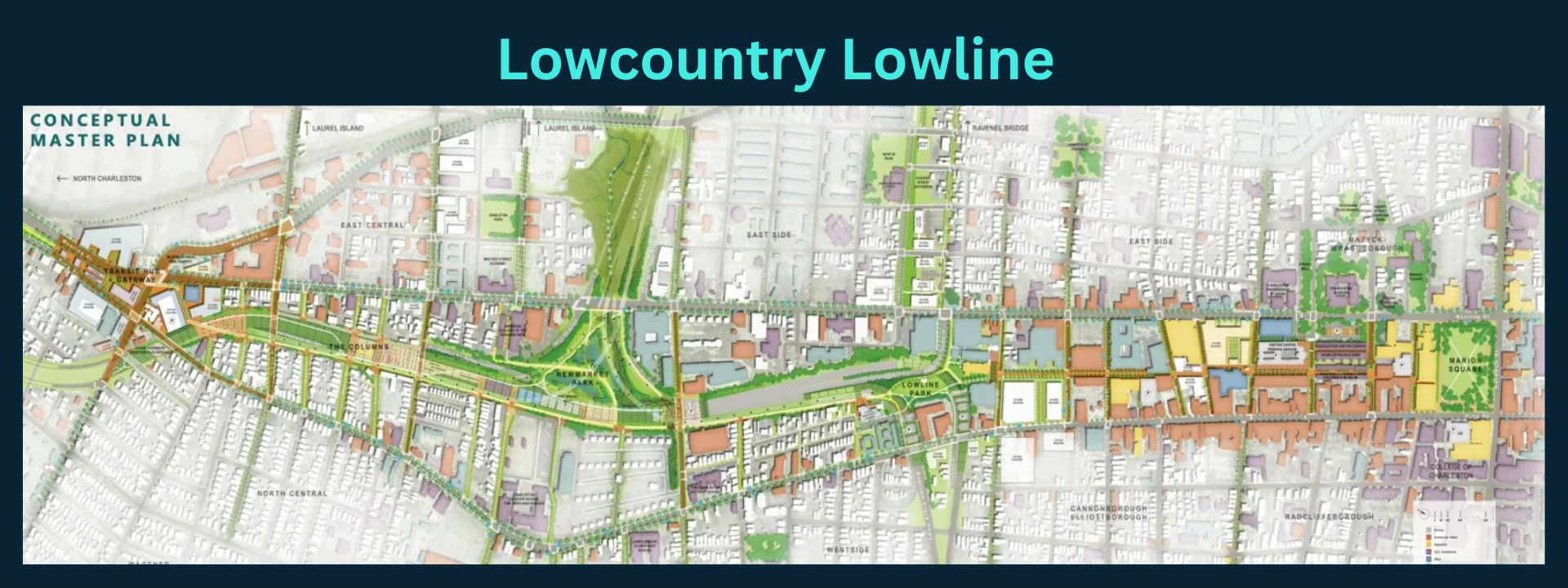
The Lowline project envisions a central spine of parks and mobility systems connecting downtown to West Ashley, North Charleston and Mt Pleasant. The plan will transform an abandoned rail line and neglected highway corridor into a continuous green corridor that supports the surrounding communities and provides places for active and passive recreation.. 

Charleston City Council recently approved a $1.1 million design-build contract, officially launching the first phase of construction for this long-awaited project. A community open house is scheduled for Thursday, April 24th from 5:00 to 6:30 p.m. at Palmetto Brewing Company, located at 289 Huger Street in Charleston.

THE NORTH CENTRAL CORRIDOR:

  • The North Central Corridor runs from Romney Street to the planned transit hub on Mount Pleasant Street
  • The North Central Corridor provides areas for active and passive recreation in “The Columns” beneath the elevated highway
  • “The Columns” area also provide ample space to host a neighborhood market
  • This district will include pocket parks where neighborhood streets end into the Lowline property
  • The potential transit oriented redevelopment of the Parks Department building provides an opportunity to create a new pedestrian district at the North end of the Lowline

THE PARKS

  • The Parks District runs from Romney Street to Line Street
  • It is bookended by two new park spaces: New Market Creek Park to the North and Lowline Park to the South
  • Lowline Park is a large open space designed for events and gatherings
  • NewMarket Park is an enhanced Salt- and Fresh- water ecosystem
  • NewMarket Park provides a natural amenity for the public to enjoy while also enhancing stormwater management for the surrounding neighborhoods

THE URBAN CORE

  • The Urban Core District of the Lowline runs from Line Street to Marion Square
  • The District currently has the most diverse mix of uses and the highest density on the peninsula
  • The Lowline in the Urban Core is envisioned to be a series of alleys
  • Some portions of the Lowline already exist as alleys between Mary and Hutson Street
  • The side streets that connect King and Meeting streets will become important access points. Improvements to these connecting streets will be included in the Lowline
  • This Network of interconnected pedestrian walkways will enhance the entire district

Read More at Lowcountry Lowline

Gena Glaze

Leave a comment

Filed under Charleston Area Growth and Development, Places, Real Estate (Market info)

SC Growth Shows No Sign of a Slow Down.

South Carolina is among a handful of Sunbelt states where growth is pulling away from the rest of the country, and one of the region’s top economists says there doesn’t seem to be anything on the horizon to stem the acceleration.

“I don’t see anything in the data that makes me think that growth in the Carolinas, in particular, is going to slow down,” Laura Ullrich, a Charlotte-based economist with the Federal Reserve Bank of Richmond, said during the S.C. International Trade Conference on the Isle of Palms.

The lures that have drawn newcomers from other states — jobs, weather and relatively lower costs — aren’t going to change, Ullrich said. Already, South Carolina ranks as the nation’s fastest-growing state percentagewise, with 1.7 percent growth in 2023, according to census data. That’s nearly 91,000 more people than the previous year, with roughly 19,000 of them moving to the three-county Charleston region.

“And, quite frankly, we still have several mid-sized metros that have a lot of growing to do,” Ullrich said

“If you live in Charleston, things seem super expensive here,” she said. “But it’s a lot cheaper than a house in Fairfax County, Virginia, and a heck of a lot cheaper than San Diego. So, if you look at the areas where that migration is coming from, they are very expensive. Yes, it’s expensive to buy a house in Mount Pleasant. But if you move from San Diego, you might buy a house in Mount Pleasant and another on Lake Murray.”

At the same time, wages are often much lower in South Carolina, and that can amplify the housing crisis regardless of cost comparisons.

“Everybody is worried about housing,” Ullrich said. “The only ways to fix it are, basically, subsidies and density. And people don’t want to talk about density. It’s really hard because everyone wants affordable housing but when density is going up down the road, people complain to their city, and they don’t do it.”

There are a few intangible variables that could crimp growth, such as rising geopolitical tensions or a surprise event that no one can forecast. But Ullrich said the biggest question is how quickly the Fed will lower interest rates going forward.

“Is it going to be an elevator or slow stair steps?” she said.

The answer could go a long way in determining how the housing crisis — both affordability and availability — shakes out in the Charleston region and throughout the Sunbelt.

Read more at Post and Courier

Gena Glaze

Leave a comment

Filed under Charleston Area Growth and Development, Real Estate (Market info), Stories, News & Events

CARTA Proposes Controversial Park and Ride Facility at Ladson Fairgrounds

Charleston Area Regional Transportation Authority’s (CARTA) plans to build a park-and-ride facility at the fairgrounds. This park-and-ride facility is a part of CARTA’s Lowcountry Rapid Transit Plan – the first-ever large-scale transportation project in the region.

CARTA Chairman Mike Seekings, says this $600 million plan is the result of over a decade of regional planning. If plans go through, the facility will take up about six acres of the 180 acres available for parking on the fairgrounds.

Mike Jernigan, a member of the Exchange Board as well as the former president of the Coastal Carolina Fair, says that their initial discussions with CARTA were about leasing an acre to an acre and a half of land for a bus stop, but he said that CARTA wanted more land to either purchase or take by eminent domain.

Seekings is surprised by this response. He says that they spoke with the leadership of the fairgrounds early in the process and have had conversations over many years about this area of land.

Officials with the Coastal Carolina Fair say that their issue is not the size of the facility, though, but the location. The park-and-ride facility would be located in lot 2A of the fairgrounds which is adjacent to Highway 78 and Gate 2 – one of the major entrances of the fairgrounds.

“We feel like supporting public transportation is a good thing. We’re not opposed to that in any way,” Jernigan says. We just feel like this location is the wrong location. That there are other options that are available adjacent to our property, or even at a different place on our property, but not to take our prime parking spot.”

Read More – News Article

Gena Glaze

Leave a comment

Filed under Charleston Area Growth and Development