What It Means To Be in a Sellers’ Market

What It Means To Be in a Sellers’ Market | MyKCM

If you’ve given even a casual thought to selling your house in the near future, this is the time to really think seriously about making a move. Here’s why this season is the ultimate sellers’ market and the optimal time to make sure your house is available for buyers who are looking for homes to purchase.

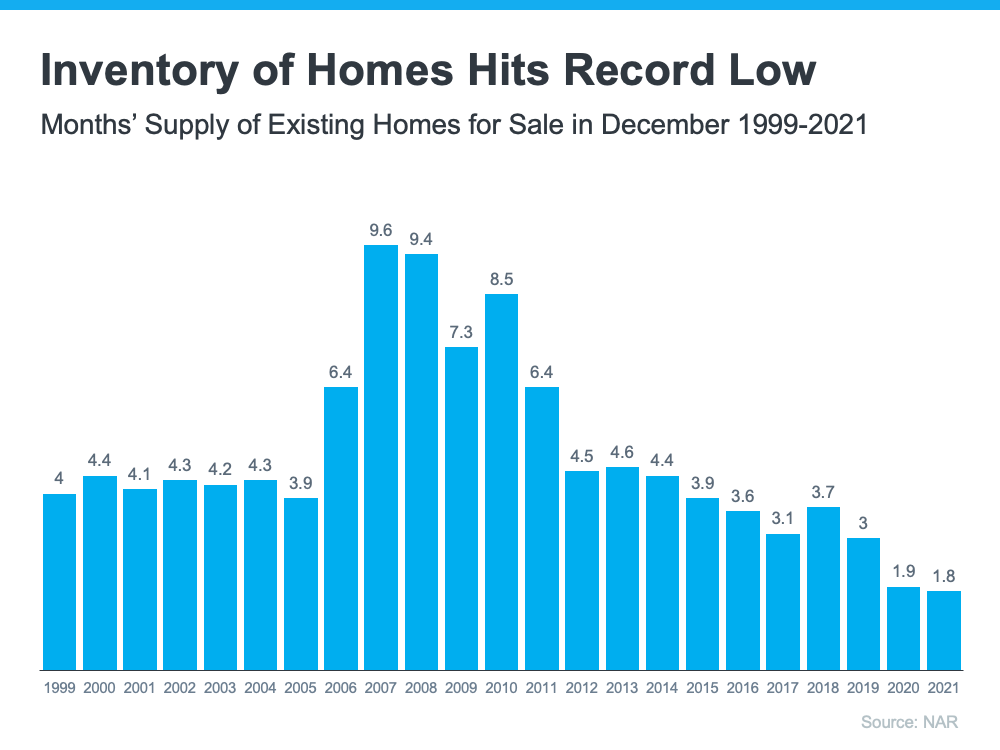
The latest Existing Home Sales Report from The National Association of Realtors (NAR) shows the inventory of houses for sale is still astonishingly low, sitting at just a 2-month supply at the current sales pace.

What It Means To Be in a Sellers’ Market | MyKCM

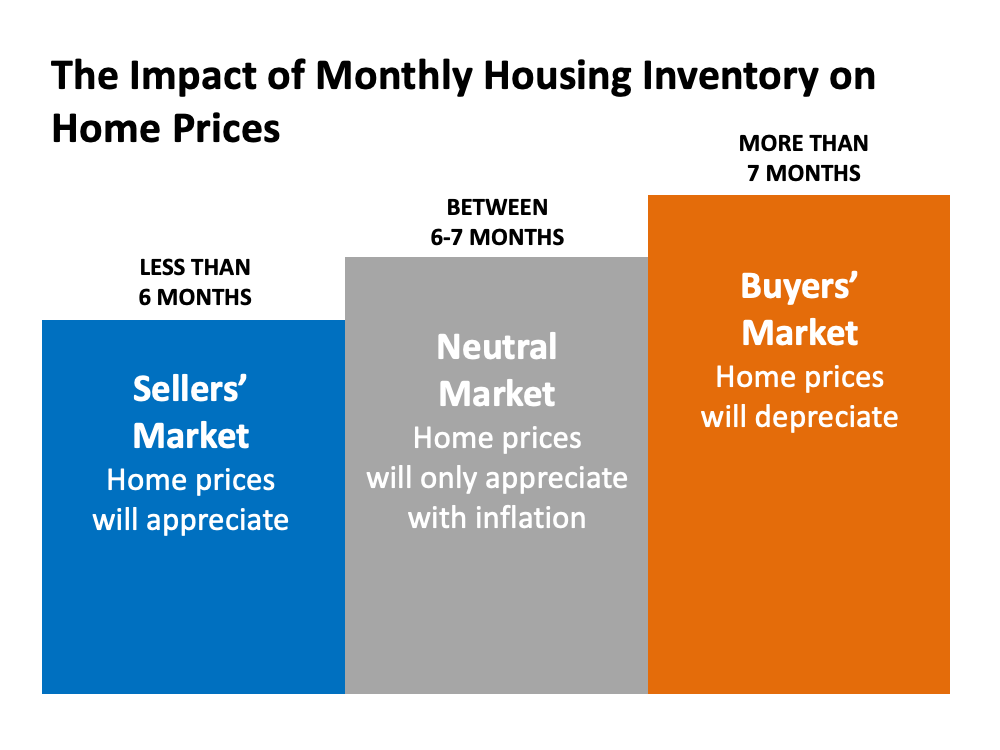
Historically, a 6-month supply is necessary for a ‘normal’ or ‘neutral’ market in which there are enough homes available for active buyers (See graph below):When the supply of houses for sale is as low as it is right now, it’s much harder for buyers to find homes to purchase. As a result, competition among purchasers rises and more bidding wars take place, making it essential for buyers to submit very attractive offers.

As this happens, home prices rise and sellers are in the best position to negotiate deals that meet their ideal terms. If you put your house on the market while so few homes are available to buy, it will likely get a lot of attention from hopeful buyers.

Today, there are many buyers who are ready, willing, and able to purchase a home. Low mortgage rates and a year filled with unique changes have prompted buyers to think differently about where they live and they’re taking action. The supply of homes for sale is not keeping up with this high demand, making now the optimal time to sell your house.

Gena Glaze

Leave a comment

Filed under Real Estate (Market info)

ARE WE IN A HOUSING BUBBLE?

Housing Bubble?

The “warning signs” look all too familiar.

Escalating home prices have both buyers & sellers worried that the market is just “too good to be true,” and agents across the U.S. are getting bombarded with the ultimate question: “Are we in a housing bubble?”

Let’s take a look at 3 key factors that suggest we’re not, so you can educate your clients and calm fears in your market.

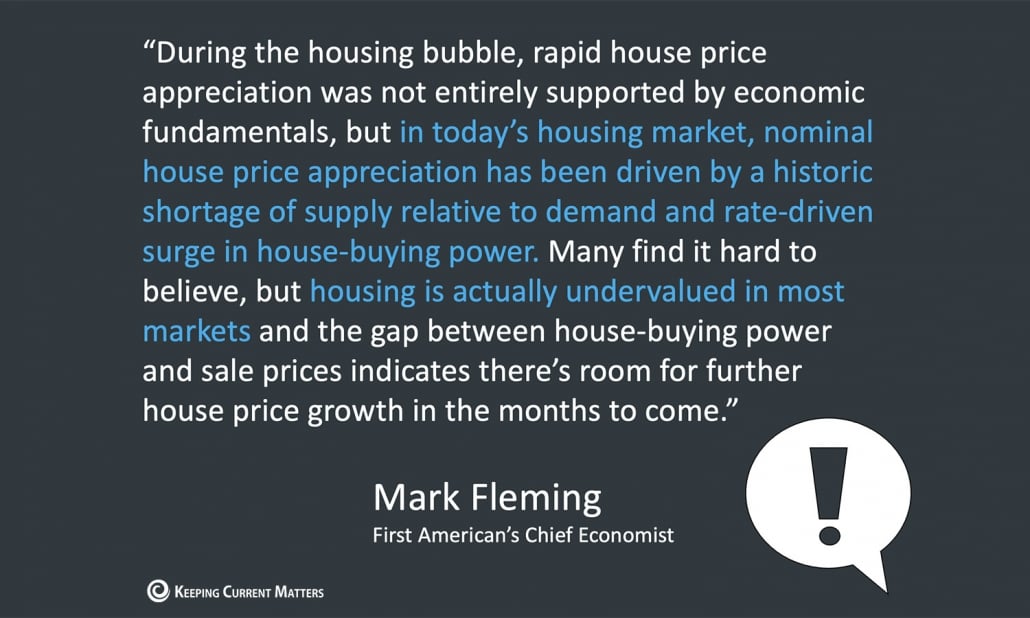
Mark Fleming Quote on Price Appreciation 2021
Part 1: Housing Supply

Last year, home values appreciated a whopping 10% on average across the country. And while this year’s growth isn’t expected to match it (experts are predicting closer to 5%), buyers and sellers are still worried that home prices are too high and that depreciation is likely to follow.

However, unlike the Housing Bubble years of the mid-2000s, the major factor driving up home values is that we are also in a dire inventory shortage.

A balanced real estate market’s inventory sits around 6 months. Today’s current market is at 1.9 months, a historically low amount of homes for sale. On top of that, inventory has slowly been declining for years now: we’ve been under 5 months inventory for the last three.

In comparison, the inventory level from 2005 and 2007 increased from 5 months to 11 months, a vast over-supply of homes that did not warrant the price appreciation that went along with it.

So, throwing it back to your high school economics class, the biggest driver of price appreciation is a simple case of supply and demand, hence what we’re seeing in the market today.

Part 2: Housing Demand

If you remember the housing boom of the mid-2000s, you know how crazy that time was in real estate. But if Robert Schiller, a fellow at the Yale School of Management’s International Center for Finance, could sum it up in one phrase, it’s this: irrational exuberance.

In other words, the buying and selling frenzy that in-part caused the market collapse was fueled not by tactful, financial decisions but a country-wide case of FOMO (fear of missing out).

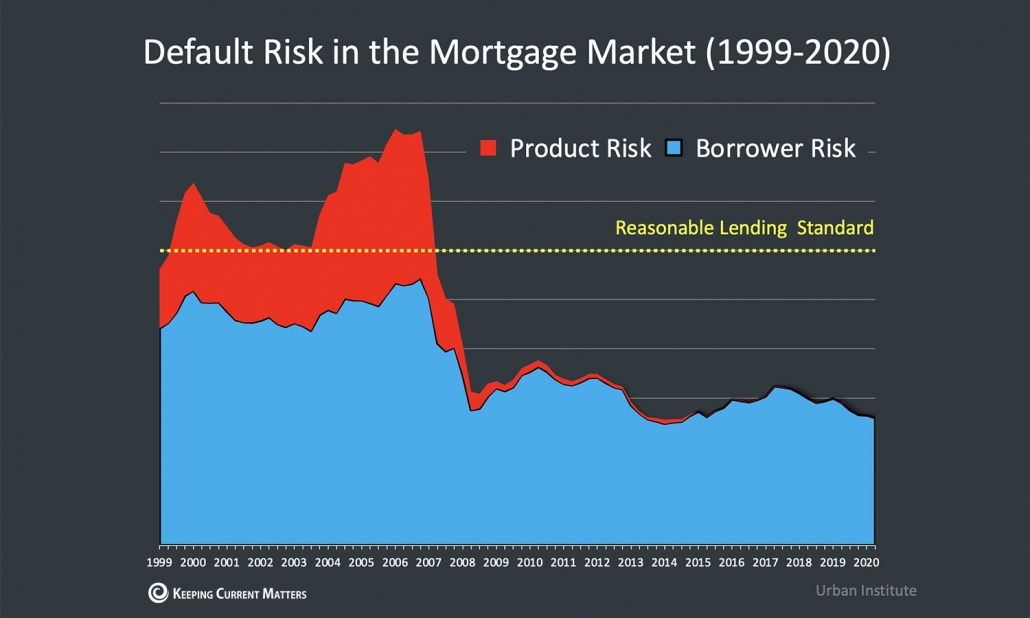
The mortgage industry fed into the frenzy, making it easy for people to obtain home loans much higher than they could afford.

Today’s real estate demand, however, is a very real thing.

Millennials, currently the largest generation in the U.S., are finally ready for homeownership and hitting the market in mass. The health crisis is also challenging homeowners to re-evaluate whether their current home meets their needs, driving more eager buyers into the market.

These two big factors, coupled with historically low mortgage rates, make purchasing a home today a good financial decision. So, not only is the demand very real, it’s also very smart.

Part 3: Equity

Following the housing and economic crash of 2008, economists, financiers, and real estate industry experts have combed through data to figure out why the entire system crumbled the way it did.

Most will agree that one of the biggest pieces of that catastrophic equation came down to this: equity. Or in reality, a lack of it.

The mid-2000s saw a massive wave of homeowners cashing out the equity in their homes. In short, they were using their homes like ATMs to afford some of the finer things in life.

This led to a lot of negative equity situations: where the amount someone owed on their home was far more than what their house was worth. Many foreclosures and short-sales followed, depreciating home values nationwide.

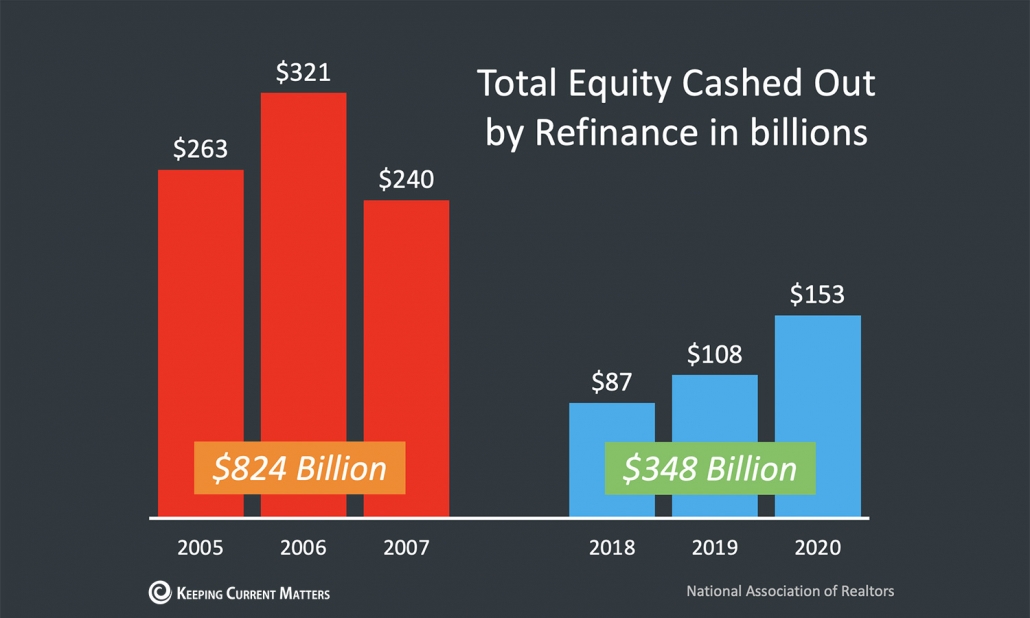
Today is a much different equity picture. Cash-out refinance volume over the last three years is less than a third of what it was compared to the three years before the crash. More than 38% of homeowners have paid off their mortgage “free and clear,” and another 18.7% have paid off over 50% of their mortgage.

This positive equity perspective puts the current housing market in a much stronger place, minimizing risk of foreclosure and stabilizing home values across the U.S.

Gena Glaze

Leave a comment

Filed under Real Estate (Market info)

What Is the Strongest Tailwind to Today’s Recovering Economy?

What Is the Strongest Tailwind to Today’s Recovering Economy? | MyKCM

Last year started off with a bang. Unemployment was under 4%, forecasters were giddy with their projections for the economy, and the residential housing market had the strongest January and February activity in over a decade.

Then came the announcement on March 11, 2020, from the World Health Organization declaring COVID-19 a worldwide pandemic. Two days later, the White House declared it a national emergency. Businesses and schools were forced to close, shelter-in-place mandates were enacted, and the economy came to a screeching halt. As a result, unemployment in this country skyrocketed to 14.9%.

A year later, the economy is recovering, and the U.S. has regained more than half of the jobs that were originally lost. However, some businesses are still closed, and many schools are still struggling to reopen. Despite the past and current challenges, there is one industry that’s proven to be a tailwind helping to counter all of these headwinds to our economy. That industry is housing. Remarkably, the residential real estate market (including existing homes and new construction) has flourished over the last twelve months. Sales are up, prices are appreciating, and more new homes are being built. The housing market has been a pillar of strength in an otherwise slowly recovering economy.

How does the real estate market help the economy?

At the beginning of the pandemic, the National Association of Realtors (NAR) released a report that explained:

“Real estate has been, and remains, the foundation of wealth building for the middle class and a critical link in the flow of goods, services, and income for millions of Americans. Accounting for nearly 18% of the GDP, real estate is clearly a major driver of the U.S. economy.”

The report calculated the total economic impact of real estate-related industries on the economy as well as the expenditures that resulted from a single home sale. At a national level, their research revealed that a single newly constructed home had an economic impact of $88,416.

What Is the Strongest Tailwind to Today’s Recovering Economy? | MyKCM

Here’s how it breaks down:The map below shows the impact by state:The impact of an existing home sale is approximately $40,000.

Real estate has done more for our economic wellbeing than virtually any other industry over the last year. It’s been a beacon of light during a very challenging time in our nation’s history.

Bottom Line

Whether you’re buying a newly constructed home or one that already exists, you’re making a positive economic impact in your local community – and it’s a step toward your homeownership goals as well.

Leave a comment

Filed under Real Estate (Market info)

FORBEARANCE Information

A federal law passed on March 27, 2020, the Coronavirus Aid, Relief, and Economic Security (CARES) Act, puts in place protections for homeowners with mortgages that are federally or Government Sponsored Enterprise (GSE) backed or funded (FHA, VA, USDA, Fannie Mae,Freddie Mac.

The CARES Act provides many homeowners with the right to have all mortgage payments completely paused for a period of time.under the CARES Act, if you have a federally or GSE-backed mortgage, you can request and obtain a forbearance for up to 180 days.

Servicers are obligated to provide a CARES Act forbearance if: (1) a borrower requests forbearance, and (2) the borrower affirms financial hardship due to the COVID-19 emergency.

Keep in mind, the missed payments are still owed, check with your servicer for individual options.

Homeowners with mortgages owned or guaranteed by Fannie Mae  or Freddie Mac  may be eligible for different repayment options following forbearance. Fannie Mae and Freddie Mac do not require a lump sum payment at the end of the forbearance.

If you can afford to resume your regular monthly mortgage payment you may be eligible for a payment deferral  which puts your missed mortgage payments into a payment due at the sale or refinancing of your home, or at the end of the loan.

FHA  does not require lump sum repayment at the end of the forbearance. The COVID-19 home retention option, called the COVID-19 Standalone Partial Claim, places amounts you owe into a junior lien that is repaid when you refinance your mortgage or sell your home or your mortgage otherwise terminates. If you do not qualify for the COVID-19 Standalone Partial Claim, FHA offers other tools to help you repay the missed payments over time.

For more information on Federal Housing Administration Mortgages: answers@hud.gov, call 1-800-CALL-FHA (1-800-225-5342), or visit www.hud.gov .

If you have an FHA, VA or USDA loan, check out this fact sheet;

Leave a comment

Filed under Real Estate (Market info)

Refinance Will Cost More! – New Adverse Market Fee – Effective Sept.1 2020

Fannie Mae and Freddie Mac announced Wednesday evening that they will now be charging a 0.5% adverse market fee on all refinances, including  cash-out and non-cash-out refi’s. This new fee goes into effect Sept. 1.

fanniefreddie

“As a result of risk management and loss forecasting precipitated by COVID-19 related economic and market uncertainty, we are introducing a new Market Condition Credit Fee in Price,” Freddie Mac said in a notice to lenders.

The Federal Housing Finance Agency, which regulates Fannie and Freddie, said the two government-sponsored enterprises “requested, and were granted, permission from FHFA to place an adverse market fee on mortgage refinance acquisitions.”

The new fee could add up to a significant sum in many cases. The median home nationwide was worth $291,300 as of the second quarter, according to the National Association of Realtors. Therefore, if you applied this fee to a mortgage on a home worth that much, assuming a 20% down payment, the fee would cost over $1,100. The Mortgage Bankers Association, a trade group that represents lenders, said the fee would amount to around $1,400 per loan on average.

 “Fannie and Freddie say they’re charging the fee to account for market uncertainty and higher risk,” said Holden Lewis, home and mortgage expert at personal-finance website NerdWallet. 
See more News regarding this topic;

Leave a comment

Filed under Real Estate (Market info)

Are We About to See a New Wave of Foreclosures?

Are We About to See a New Wave of Foreclosures? | MyKCM


With all of the havoc being caused by COVID-19, many are concerned we may see a new wave of foreclosures. Restaurants, airlines, hotels, and many other industries are furloughing workers or dramatically cutting their hours. Without a job, many homeowners are wondering how they’ll be able to afford their mortgage payments.

In spite of this, there are actually many reasons we won’t see a surge in the number of foreclosures like we did during the housing crash over ten years ago. Here are just a few of those reasons:

The Government Learned its Lesson the Last Time

During the previous housing crash, the government was slow to recognize the challenges homeowners were having and waited too long to grant relief. Today, action is being taken swiftly. Just this week:

  • The Federal Housing Administration indicated it is enacting an “immediate foreclosure and eviction moratorium for single family homeowners with FHA-insured mortgages” for the next 60 days.
  • The Federal Housing Finance Agency announced it is directing Fannie Mae and Freddie Mac to suspend foreclosures and evictions for “at least 60 days.”

Homeowners Learned their Lesson the Last Time

When the housing market was going strong in the early 2000s, homeowners gained a tremendous amount of equity in their homes. Many began to tap into that equity. Some started to use their homes as ATM machines to purchase luxury items like cars, jet-skis, and lavish vacations. When prices dipped, many found themselves in a negative equity situation (where the mortgage was greater than the value of their homes). Some just walked away, leaving the banks with no other option but to foreclose on their properties.

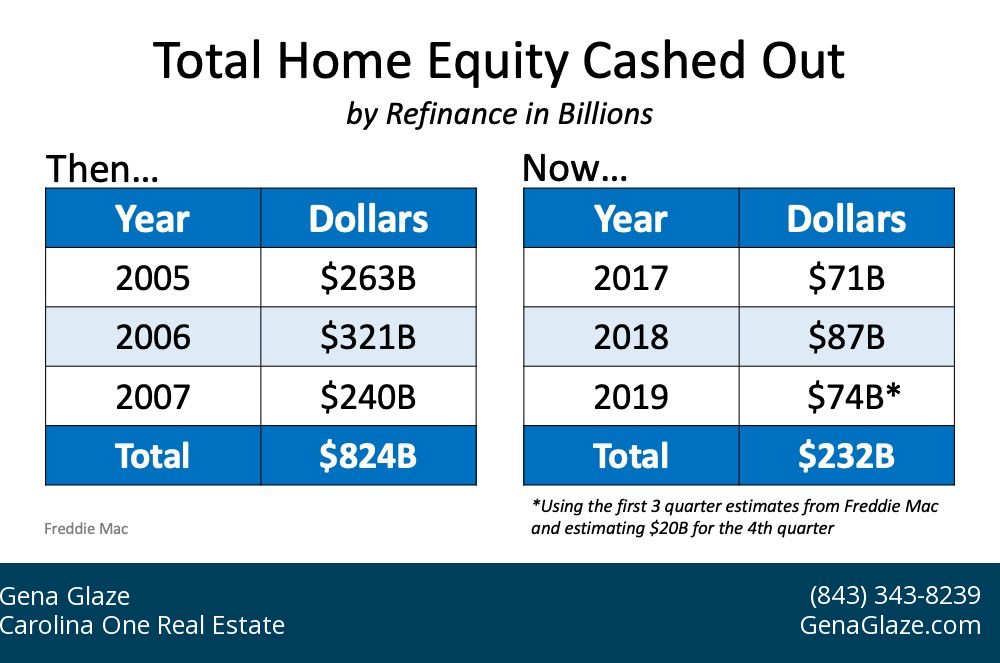
Today, the home equity situation in America is vastly different. From 2005-2007, homeowners cashed out $824 billion worth of home equity by refinancing. In the last three years, they cashed out only $232 billion, less than one-third of that amount. That has led to:

  • 37% of homes in America having no mortgage at all
  • Of the remaining 63%, more than 1 in 4 having over 50% equity

Even if prices dip (and most experts are not predicting that they will), most homeowners will still have vast amounts of value in their homes and will not walk away from that money.

There Will Be Help Available to Individuals and Small Businesses

The government is aware of the financial pain this virus has caused and will continue to cause. Yesterday, the Associated Press reported:

“In a memorandum, Treasury proposed two $250 billion cash infusions to individuals: A first set of checks issued starting April 6, with a second wave in mid-May. The amounts would depend on income and family size.”

The plan also recommends $300 billion for small businesses.

Bottom Line

These are not going to be easy times. However, the lessons learned from the last crisis have Americans better prepared to weather the financial storm. For those who can’t, help is on the way.

Gena Glaze

Contact me for more information!

843-343-8239


Leave a comment

Filed under Real Estate (Market info)

5 Simple Graphs Proving This Is NOT Like the Last Time!

Apple and orange against yellow and green background
With all of the volatility in the stock market and uncertainty about the Coronavirus (COVID-19), some are concerned we may be headed for another housing crash like the one we experienced from 2006-2008. The feeling is understandable. Ali Wolf, Director of Economic Research at the real estate consulting firm Meyers Research, addressed this point in a recent interview:

“With people having PTSD from the last time, they’re still afraid of buying at the wrong time.”

There are many reasons, however, indicating this real estate market is nothing like 2008. Here are five visuals to show the dramatic differences.

1. Mortgage standards are nothing like they were back then.
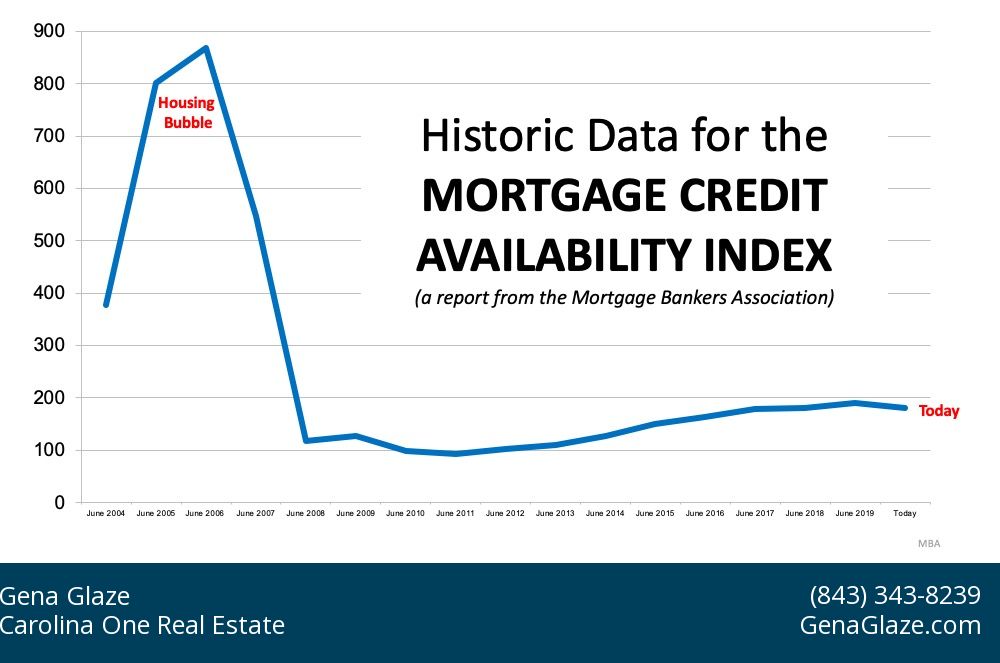
During the housing bubble, it was difficult NOT to get a mortgage. Today, it is tough to qualify. The Mortgage Bankers’ Association releases a Mortgage Credit Availability Index which is “a summary measure which indicates the availability of mortgage credit at a point in time.” The higher the index, the easier it is to get a mortgage. As shown below, during the housing bubble, the index skyrocketed. Currently, the index shows how getting a mortgage is even more difficult than it was before the bubble.

1

2. Prices are not soaring out of control.
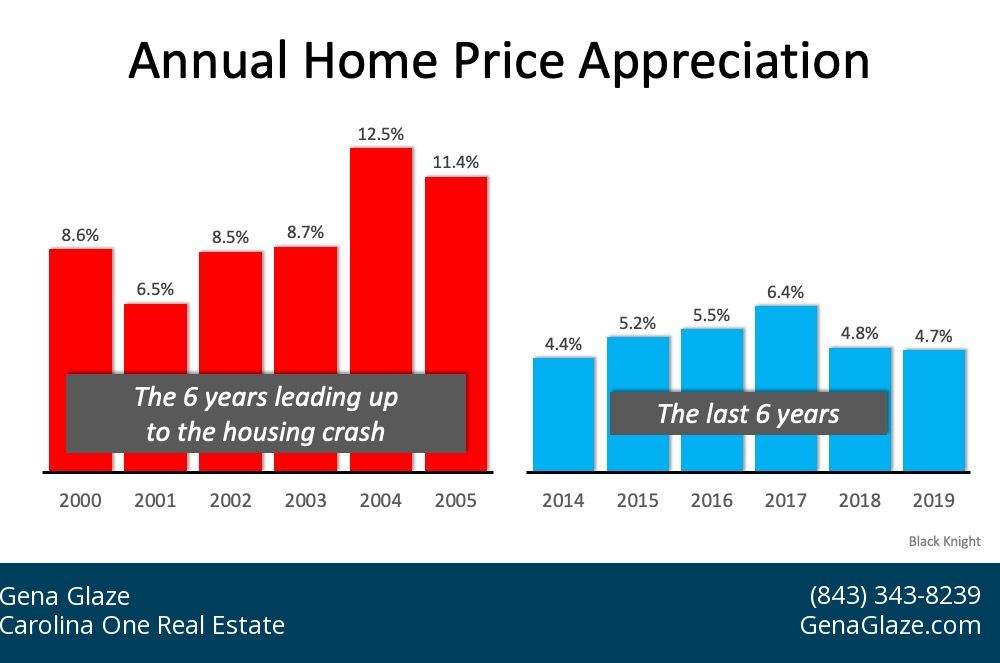
Below is a graph showing annual house appreciation over the past six years, compared to the six years leading up to the height of the housing bubble. Though price appreciation has been quite strong recently, it is nowhere near the rise in prices that preceded the crash.5 Simple Graphs Proving This Is NOT Like the Last Time

2

3. We don’t have a surplus of homes on the market. We have a shortage.
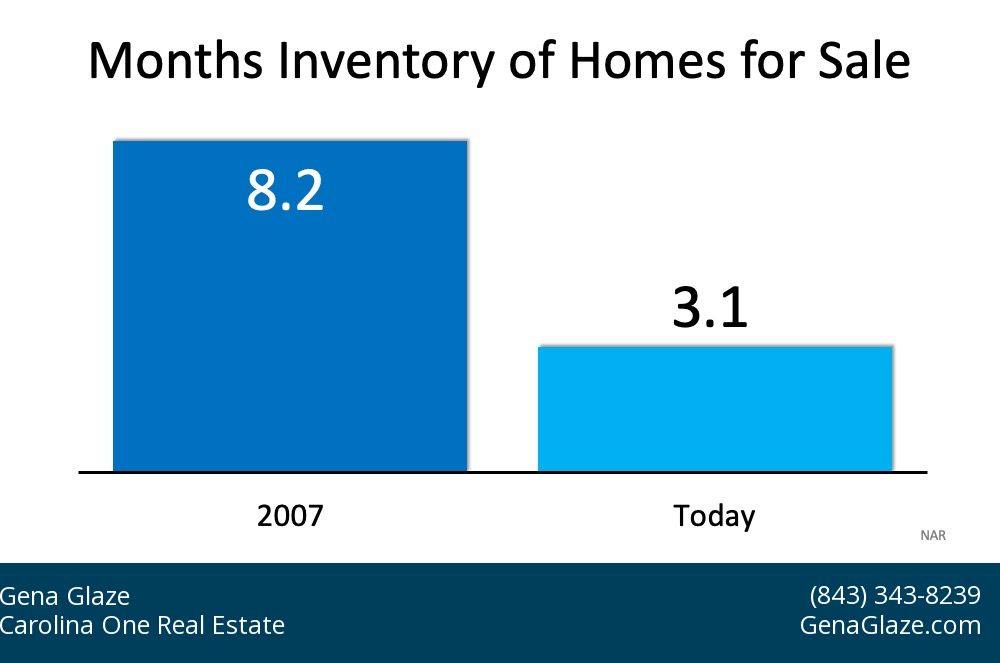
The months’ supply of inventory needed to sustain a normal real estate market is approximately six months. Anything more than that is an overabundance and will causes prices to depreciate. Anything less than that is a shortage and will lead to continued appreciation. As the next graph shows, there were too many homes for sale in 2007, and that caused prices to tumble. Today, there’s a shortage of inventory which is causing an acceleration in home values.

3

4. Houses became too expensive to buy.
The affordability formula has three components: the price of the home, the wages earned by the purchaser, and the mortgage rate available at the time. Fourteen years ago, prices were high, wages were low, and mortgage rates were over 6%. Today, prices are still high. Wages, however, have increased and the mortgage rate is about 3.5%. That means the average family pays less of their monthly income toward their mortgage payment than they did back then.

4


5. People are equity rich, not tapped out.
In the run-up to the housing bubble, homeowners were using their homes as a personal ATM machine. Many immediately withdrew their equity once it built up, and they learned their lesson in the process. Prices have risen nicely over the last few years, leading to over fifty percent of homes in the country having greater than 50% equity. But owners have not been tapping into it like the last time. Here is a table comparing the equity withdrawal over the last three years compared to 2005, 2006, and 2007. Homeowners have cashed out over $500 billion dollars less than before.5

During the crash, home values began to fall, and sellers found themselves in a negative equity situation (where the amount of the mortgage they owned was greater than the value of their home). Some decided to walk away from their homes, and that led to a rash of distressed property listings (foreclosures and short sales), which sold at huge discounts, thus lowering the value of other homes in the area. That can’t happen today.

Bottom Line
If you’re concerned we’re making the same mistakes that led to the housing crash, take a look at the charts and graphs above to help alleviate your fears.

Additionally, The new business growth and relocation’s to the Charleston area along with the population growth could prove to keep our housing market stable.

Gena Glaze Contact me! 843-343-8239

Leave a comment

Filed under Real Estate (Market info)

Will the Fed bond-buying drive 30 Year fixed mortgage rates below 3%??

It’s “certainly possible,” CoreLogic chief economist says

InterestRates-Slides-20200311-Slide16

From Housing Wire

Deep inside the fortress-like headquarters of the Federal Reserve Bank of New York in lower Manhattan, a group of market specialists on Monday re-started the bond-buying program that during the financial crisis was known as quantitative easing, or QE.

In a surprise announcement on Sunday, the Fed’s rate-setting Federal Open Market Committee said it would buy $500 billion in Treasury bills and $200 billion of agency-backed mortgage securities. In addition, it said it would reinvest run-off from its existing portfolio of mortgage bonds.

The Fed launched three rounds of a similar bond-buying more than a decade ago aimed at saving the housing market and stimulating economic growth during the financial crisis. The first phase, started in December 2008, helped to drive mortgage rates below 5% for the first time ever.

The Fed also said on Sunday it was slashing 1% from its benchmark rate, putting it near zero for the first time since the financial crisis, a move that will make business borrowing cheaper and help homeowners with equity loans tied to the prime rate, which moves in tandem with the Fed rate.

But for the mortgage market, the QE program and the pledge to reinvest MBS runoff was the big news because it will increase competition for agency bonds. When demand goes up, yields go down, and that usually translates into lower mortgage rates.

“The Fed is creating liquidity and creating demand for mortgage-backed securities, which drives down rates,” said Mark Goldman, a loan officer with C2 Financial in San Diego. “It will take a few weeks for things to settle down, but once that happens we could see rates return to record lows of near 3%, and there’s a chance we could see a sub-3% rate for a 30-year fixed conforming loan.”

Frank Nothaft, CoreLogic’s chief economist, said the new lows in rates could come just as the housing market’s spring selling season hits its stride.

“It may not be tomorrow or next week, but I think longer term as we look to the spring, yes, I think we could see rates moving down to new lows and possibly below 3%,” Nothaft said. “It’s certainly possible.


For More Information, Contact me!    843-343-8239

Gena Glaze

Real Estate Matters – Charleston SC

Leave a comment

Filed under Real Estate (Market info)

FOUR REASONS TO BUY THIS FALL!


4 Reasons to Buy a Home This Fall


Here are four great reasons to consider buying a home today, instead of waiting.

1. Prices Will Continue to Rise

CoreLogic’s latest Home Price Insights Report shows that home prices have appreciated by 3.6% over the last 12 months. The same report predicts prices will continue to increase at a rate of 5.8% over the next year.

The bottom in home prices has come and gone. Home values will continue to appreciate for years. Waiting no longer makes sense.

2. Mortgage Interest Rates Are Projected to Increase Next Year

The Primary Mortgage Market Survey from Freddie Mac indicates that interest rates for a 30-year mortgage have recently hovered just above 3.5%. This is great news for buyers in the market right now, because low interest rates increase your purchasing power – but don’t wait! Most experts predict rates will rise over the next 12 months. The Mortgage Bankers Association, Fannie Mae, Freddie Mac, and the National Association of Realtors are in unison, projecting that rates will increase by this time next year.

An increase in rates will impact your monthly mortgage payment. A year from now, your housing expense will increase if a mortgage is needed to buy your next home.

3. Either Way, You Are Paying a Mortgage

There are some renters who haven’t purchased a home yet because they’re uncomfortable taking on the obligation of a mortgage. Everyone should realize that, unless you’re living rent-free with your parents, you are paying a mortgage – either yours or that of your landlord.

As an owner, your mortgage payment is a form of ‘forced savings’ that allows you to have equity in your home you can tap into later in life. As a renter, you guarantee your landlord is the person with that equity.

Are you ready to put your housing costs to work for you?

4. It’s Time to Move on With Your Life

The ‘cost’ of a home is determined by two major components: the price of the home and the current mortgage rate. It appears both are on the rise.

But what if they weren’t? Would you wait?

Look at the actual reason you’re buying and decide if it is worth waiting. Whether you want to have a great place for your children to grow up, you want your family to be safer, or you just want to have control over custom renovations, maybe now is the time to buy.

Bottom Line
Buying a home sooner rather than later could lead to substantial savings. Reach out to a local real estate professional to determine if homeownership is the right choice for you and your family this fall.

Leave a comment

Filed under Real Estate (Market info)

Home Buying Lingo!

Illustration of people with speech bubbles using mobile phones while walking on street against clear

Some Highlights:

  • Learning the lingo of homebuying is an important part of feeling successful when buying a home.
  • From APR to P&I, you need to know the acronyms that will come up along the way, and what they mean when you hear them.
  • Your local professionals are here to help you feel confident and informed from start to finish…and this infographic will help you as you go.

Leave a comment

Filed under Learn Real Estate Terms, Real Estate (Market info)