A Berkeley County property owner can peek through a stand of trees across the road and see part of Cane Bay Plantation. The other side of his land overlooks 1,700 acres of undeveloped land where Seattle-based Weyerhaeuser, the nation’s largest timber tract owner, wants to build another large-scale residential project.
Mr. Burbage Smoak’s property along the heavily traveled, two-lane Black Tom Road stands in the way of any plans Weyerhaeuser might have and Berkeley County Council appears determined to keep it that way.
Smoak’s vacant property includes 421 acres southwest of Moncks Corner, most of it is wetlands. However, He wants to build a strip of commercial buildings on 80 acres that front Black Tom Road — maybe some medical offices or retail space, something that will “support the residents of that area,” according to Kevin Berry, president of Earthsource Engineering, who is representing the landowner.
“We’re not just trying to put more residential rooftops in the area,” he said, adding he’s keenly aware of county council’s desire to slow residential growth so new roads and other critical infrastructure can catch up.
“The public sentiment, and they’ve articulated it well, is there’s frustration when development comes before infrastructure,” said county supervisor Johnny Cribb.
South Carolina is among a handful of Sunbelt states where growth is pulling away from the rest of the country, and one of the region’s top economists says there doesn’t seem to be anything on the horizon to stem the acceleration.
“I don’t see anything in the data that makes me think that growth in the Carolinas, in particular, is going to slow down,” Laura Ullrich, a Charlotte-based economist with the Federal Reserve Bank of Richmond, said during the S.C. International Trade Conference on the Isle of Palms.
The lures that have drawn newcomers from other states — jobs, weather and relatively lower costs — aren’t going to change, Ullrich said. Already, South Carolina ranks as the nation’s fastest-growing state percentagewise, with 1.7 percent growth in 2023, according to census data. That’s nearly 91,000 more people than the previous year, with roughly 19,000 of them moving to the three-county Charleston region.
“And, quite frankly, we still have several mid-sized metros that have a lot of growing to do,” Ullrich said
“If you live in Charleston, things seem super expensive here,” she said. “But it’s a lot cheaper than a house in Fairfax County, Virginia, and a heck of a lot cheaper than San Diego. So, if you look at the areas where that migration is coming from, they are very expensive. Yes, it’s expensive to buy a house in Mount Pleasant. But if you move from San Diego, you might buy a house in Mount Pleasant and another on Lake Murray.”
At the same time, wages are often much lower in South Carolina, and that can amplify the housing crisis regardless of cost comparisons.
“Everybody is worried about housing,” Ullrich said. “The only ways to fix it are, basically, subsidies and density. And people don’t want to talk about density. It’s really hard because everyone wants affordable housing but when density is going up down the road, people complain to their city, and they don’t do it.”
There are a few intangible variables that could crimp growth, such as rising geopolitical tensions or a surprise event that no one can forecast. But Ullrich said the biggest question is how quickly the Fed will lower interest rates going forward.
“Is it going to be an elevator or slow stair steps?” she said.
The answer could go a long way in determining how the housing crisis — both affordability and availability — shakes out in the Charleston region and throughout the Sunbelt.
NEW SALES – Pending (Ratified contracts) Down -6% in August of ’24 versus August of ’23. See Chart below – The orange line represents ratified contracts by week last year…the green line is this year…and the blue line is the 15 year average for each week. Follow the green line below.
*written sales (ratified contracts) reflect buyer sentiment and predict the number of closed sales in a month or two as ratified contracts typically close within 4-8 weeks.
CLOSED SALES 149I homes closed in August 2024 down -7.9% from August of 2023
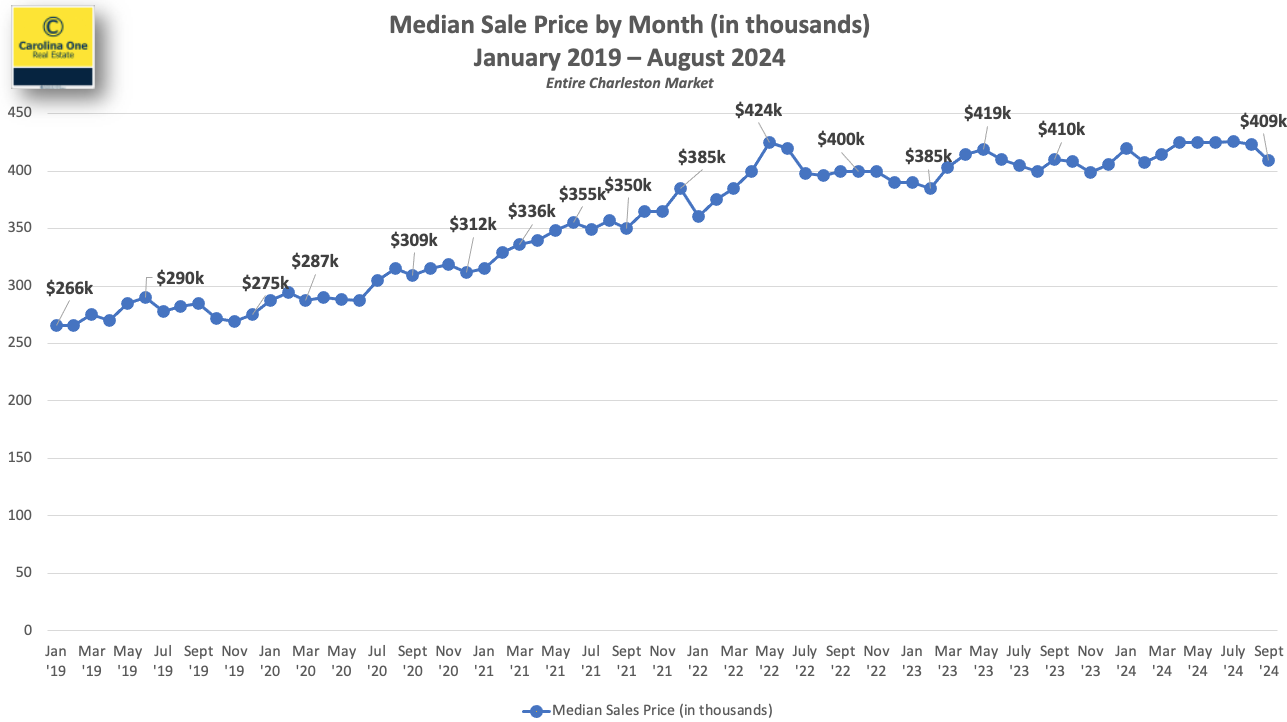
MEDIAN SALES PRICE The Median sale price in the Charleston market $422,670, up 5.67% from August 2023 and has continued to stay in a tight band between $400k and $425k for most of the last 26+ months.
The Average sales price was $617,873, up 11.54% from August of 2024
AVERAGE SOLD PRICE PER SQFT While the median sales price is remaining in a tight band, The Average Sold Dollar per sqft remains near an all-time high, at about $291 / SQFT. This means that homes are continuing to appreciate despite a stable median Sale Price
SEASONAL STATS The seasonal surge in median price that is typically experienced in the spring/summer market trended about 6% above last year’s seasonal surge, suggesting that the current pricing in our market has a solid base and given low inventory levels relative to sales, could mean that additional price gains lie ahead.
*Please note that all real estate is local; some local submarkets where there is a lot of new construction in close proximity and similarly priced are seeing prices advance more slowly.
INVENTORY Active Inventory was at approximately 4,000 listings in August, which is a significant increase over the 1,035 listing “floor” that we set in February of 2022. However, we need approximately 3,500 additional listings, market wide, to achieve a balanced market (5 months of inventory). The gap between the number of listings available for sale and the number of listings needed to maintain a balanced market is still substantial. see chart below
Approximately 1,928 new listings came online in August, well ahead of last year’s numbers, which should help drive sales later this year.
The Charleston market has about ten weeks of inventory as a whole, still leaning toward a seller’s market (this varies by price range and specific location). The most active areas have inventory levels are in the 4-6 week range.
NEW CONSTRUCTION New construction represents 45% of all pending contracts in the MLS and comprises about 36% of the closings
FORECLOSURES AND SHORT SALES Foreclosures and Short Sale combined are at 0.9% of all available listings.This is down from 1.8% of all available listings on 1/1/2020. This are very few “newly distressed” properties in the pipeline.
Record home equity is driving the historically low delinquency rate along with high levels of employment. Homeowners do not want to lose their equity.
MILLION DOLLAR PLUS MARKET We are at roughly double the monthly pre-pandemic sales levels of $1MM+ properties. This market segment remains robust.
If you would like more market information or have a real estate need, don’t hesitate to contact me!
The Real estate market is still active and the median sales price continues to remain steady – It has been roughly between 400k and 425K for over 24 months. Inventory is still below what is needed for a balanced market, but new listings are rising. Below are July 2024 calculations.
PRICE: The median sales price was $425,473, up about 5% from July 2023. The average sales price was $658,344. The median price per sqft was $228 and the average was $300 / sqft
NEW SALES: Pending sales for July were at 2,139 up 15.3 from July 2023
SUPPLY: There were 2139 New Listings in July 2024 – up 15.6%. The median days on market was 20, with approximately 2.9 months of inventory. Still under the 5 months of inventory recommended for a balanced market.
CLOSED SALES: 382 properties closed in July 2024 which is up 10 percent from July of 2023.
SmartAsset examined the latest IRS data to find where households earning $200,000 annually or more are moving.
North Carolina and South Carolina ranked third and fourth for most high-earning households moving in, with a net gain of 5,792 and 5,270 households, respectively. The average household income of high-earning households moving in is $456,000 for North Carolina and $501,000 for South Carolina.
After the latest reports on the economy, inflation, the unemployment rate, and the Federal Reserve’s recent comments, mortgage rates started dropping. And according to Freddie Mac, they’re now at a level we haven’t seen since February – see graph below:
The Relationship Between Rates and Demand
In the housing market, there’s generally a relationship between mortgage rates and buyer demand. As rates go down, buyer demand typically increases. Buyers who were on the fence over higher rates may resume their searches.
“If you’re ready to buy, now might be the time to strike. Home prices have been rising primarily because of a longstanding shortage of homes for sale. That’s unlikely to change, and if mortgage rates do fall below 6%, it’s possible buyers would enter the market in masse, further pushing up prices and resurrecting bidding wars.”
If you’re ready to start the process, I’d love to help! Feel Free to contact me anytime!
Post and Courier recently reported that South Carolina could grow to nearly 6.4 million residents by 2042 based on the state’s latest projections . The bulk of this growth is projected to be in 5 S.C. counties.
Five counties could see their populations increase by 49 percent or more from 2024 to 2042.
Horry County tops the list with an expected gain of 216,662 additional residents, which means a 53 percent population increase.
Berkeley, Jasper, Lancaster and Spartanburg counties are expected to see gains between 49 and 51 percent.
The five counties are expected to see more than 80 percent of the statewide population growth. The projected increases in population are: Horry, 216,662; Spartanburg, 179,078; Greenville, 153,555; Berkeley, 130,232; and York, 119,111.
Every county touching the Atlantic Ocean is expected to gain residents. At the north end of the coast and home to Myrtle Beach and Conway, Horry County has been among the nation’s fastest-growing places for many years and would be South Carolina’s fastest-growing county.
The tri-county Charleston metro area is expected to have more than 1 million residents in 2042, with the two inland counties — where there’s more undeveloped land — leading the gains. Berkeley County’s population could account for more than 70 percent of the growth, while the populations of Charleston and Dorchester counties are projected to increase by 8 and 11 percent, respectively.
Down the coast, the ever-growing Hilton Head/Beaufort/Bluffton area in Beaufort and Jasper counties could gain more than 45,000 residents.
South Carolina’s population was the most rapidly growing in the nation in 2023. The state had a slightly negative birth rate, with more deaths than births, so the population increase was entirely due to people moving to the state.
The state’s projections use existing data and trends to look ahead nearly 20 years, and assume growth follows patterns seen today. Of course, those patterns could change.
As we move into the second half of 2024, here’s what experts say you should expect for home prices, mortgage rates, and home sales.
Home Prices Are Expected To Climb Moderately
Home prices are forecasted to rise at a more normal pace. The graph below shows the latest forecasts from seven of the most trusted sources in the industry:
The reason for continued appreciation? The supply of homes for sale. Jessica Lautz, Deputy Chief Economist at the National Association of Realtors (NAR), explains:
“One thing that seems to be pretty solid is that home prices are going to continue to go up, and the reason is that we don’t have housing inventory.”
While inventory is up compared to the last couple of years, it’s still low overall. And because there still aren’t enough homes to go around, that’ll keep upward pressure on prices.
If you’re thinking of buying, the good news is you won’t have to deal with prices skyrocketing like they did during the pandemic. Just remember, prices aren’t expected to drop. They’ll continue climbing, just at a slower pace.
Mortgage Rates Are Forecast To Come Down Slightly
One of the best pieces of news for both buyers and sellers is that mortgage rates are expected to come down a bit, according to Fannie Mae, the Mortgage Bankers Association (MBA), and NAR (see chart below):
When you buy, even a small drop in mortgage rates can make a big difference in your monthly payments. For sellers, lower rates will bring more buyers back into the market, which can help you sell faster and potentially at a higher price.
Home Sales Are Projected To Hold Steady
For 2024, the number of home sales will be about the same as last year and may even rise slightly. The graph below compares the 2024 home sales forecasts from Fannie Mae, MBA, and NAR to the 4.8 million homes that sold last year:
The average of the three forecasts is about 5 million sales in 2024 – a small increase from 2023. Lawrence Yun, Chief Economist at NAR, explains why:
“Job gains, steady mortgage rates and the release of inventory from pent-up home sellers will lead to more sales.”
With more inventory available and mortgage rates expected to go down, a few more homes are expected to be sold this year compared to last year.
The average of the three forecasts is about 5 million sales in 2024 – a small increase from 2023. Lawrence Yun, Chief Economist at NAR, explains why:
“Job gains, steady mortgage rates and the release of inventory from pent-up home sellers will lead to more sales.”
With more inventory available and mortgage rates expected to go down, a few more homes are expected to be sold this year compared to last year. This means more people will be able to move.
If you have considered buying or selling, feel free to contact me anytime! I have 25 years’ experience and can help you navigate today’s market to reach your goals.
The Median sales Price at the end of June in the Charleston MLS was $425,000 and the average sales price $646,792
The Median sale price in the Charleston market continues to stay in a tight band between $400k and $425k where it has been for most of the last 24+ months. In June, the Median Sale Price matched it’s all time high of approximately $425,000 – has remained at that level for three consecutive months.
The seasonal surge in median is trending about 3% above last year’s seasonal surge, suggesting that the current pricing in our market has a solid base for additional price gains.
WRIITEN SALES
Written sales market-wide finished +3% in June of ’24 versus June of ’23, the first year-over-year increase in 2024. This is an indicator of future sales.
Last week saw 281 properties go under contract market-wide.
The orange line represents ratified contracts by week last year…the green line is this year…and the blue line is the 15 year average for each week.
Follow the green line below.
Using a median gives you the middle point of the data that is less likely to be skewed, Most experts believe it is best for tracking data Longterm.
PRICE PER SQFT
While the median sales price is remaining in a tight band, The Average Sold Dollar per sqft remains at an all-time high, well above one year ago, indicating that consumers are getting a smaller house for the money and that homes are continuing to appreciate despite a stable median Sale Price
INVENTORY
2,113 New listings came on the market in June 2024 which is a 6.1 % increase over June of 2023 and year to date, there is a16.6% increase of new listings over 2023.
Active Inventory stands at approximately 3,800 listings in mid July.
While this level of inventory is a significant increase over the 1,035 listing “floor” that we set in February of 2022, we still need roughly 4,300 additional listings market wide to achieve a balanced market (5 months of inventory)
The gap between the number of listings available for sale and the number of listings needed to maintain a balanced market is substantial. see chart below.
NEW CONSTRUCTION SALES
New construction represents 42% of all pending contracts in the MLS and new construction comprises about 38% of the closings.
DISTRESSED PROPERTIES
Foreclosures and Short Sales continue to hold at a combined 0.9% of all available listings currently. They are still at extremely low levels.
OVER-MILLION MARKET
We are at roughly double the monthly pre-pandemic sales levels of $1MM+ properties. This market segment remains surprisingly robust.
These statistics reflect the entire Charleston Metro area, but real estate is hyper-local and can vary by area and neighborhood. If you would like information about your neighborhood and home, please don’t hesitate to contact me!
At the end of May 2024, the median sales price closed out in the Charleston MLS at $425,000 and Median Days on Market was 12.
The current level of demand, although down 40% from 2021, is pacing around the 15 year average and is happening when interest rates are the highest that they have been in 20-25 years . Further, prices are hovering at their record highs and have been for aproximately18 months. This means that affordability is more challenging than it has been for the last few decades (high prices + high rates) and yet sales sit at a historically appropriate level in terms of units. This suggests that the consumer wants and/or needs housing to the point where they are willing to deal with affordability issues – at least for now.
The chart below shows this year’s number of ratified contracts market wide by week (green), last year’s number (orange) and the 15 year average (blue). As you can see, the green line has tracked very closely with the blue line with only two weeks well below the 15 year average and one week well above the 15 year average.
Supply
When a life change occurs (Marriage, death, additions to a family, new job, etc) frequently, housing needs change which often leads to a new listing entering the housing market.
Over the last few years, we’ve seen a pause in this cycle as interest rates have risen rapidly from the 3 percent range into the mid 7 percent range. Homeowners who have a mortgage in place at a very low interest rate are reluctant to part with that low rate and move into a home, with a higher rate, that may better suits their needs.
According to ICE Mortgage Technology, over 90% of the mortgages in the United States have a mortgage rate under 6%.
See below from ICE:
Change still happens in people’s lives and homeowners can only hold back for so long. They will eventually list their homes (move) when the life circumstances dictate the need is great, despite the rate differential. We have been seeing this happen.
This trend started in November of 2023. In the chart below, the orange line shows listings taken in the most recent 12 months and the blue line shows the prior 12 months. You’ll note that, inside the red circle (November onward), new listings taken have outpaced the prior year every month.
A Balanced Market
A “balanced market” is generally considered to be when we have around 5 months of inventory, meaning that the current level of listings, if no new properties enter the market, would sell down to zero in five months based on current sales levels. On average, it would take five months (150 days) to sell a home.
Months of inventory” is simply a way of measuring supply and demand, which of course is what drives pricing.
At roughly five months of inventory, home prices stabilize
If we have less than five months of inventory, prices generally increase
If we have more than 5-6 months of inventory, prices generally soften
Where is the Charleston housing market’s month’s of supply currently?
At May’s end MLS stats reflected approximately 2.6 month’s supply of inventory, still leaning toward a Seller’s market.
Below is to illustrate the gap (red arrow) between the inventory that we have (blue line) and the inventory that we need in order to have a balanced market (yellow line):
What does this mean?
For now, we don’t have enough inventory to meet demand (although inventory is slowly building)
Too little inventory for demand means that there is good support for current prices and perhaps a little more room for prices to grow
Worth noting:
Over the last 4 years or so, the market has been so imbalanced in favor of sellers that we now often see listing agents and/or sellers get uncomfortable/nervous/start to panic after a mere week or two on the market without a sale
What we’ve experienced over the last few years has skewed expectations to the point where favorable selling conditions that aren’t quite a “hot” market feels like things are “slow”